
Your car got fixed, but it’s still worth less than it was the day before the wreck. That gap has a name: diminished value. In Texas, whether you can collect it, and from whom, depends on one key fact: who’s paying.
Diminished Value Claims in Texas
Diminished value is the resale value your car loses just from having an accident on its record, even after a proper repair. Texas measures damage to your property as the difference between what it was worth right before the crash and what it’s worth right after, and that same before-and-after measure supports recovering the value that’s still missing once the repairs are done.
That is not double-dipping: the diminished value figure and the repair bill cover two different losses, one for the physical damage and one for the resale value that never fully comes back, according to the Texas Supreme Court’s ruling in Parkway Co. v. Woodruff.
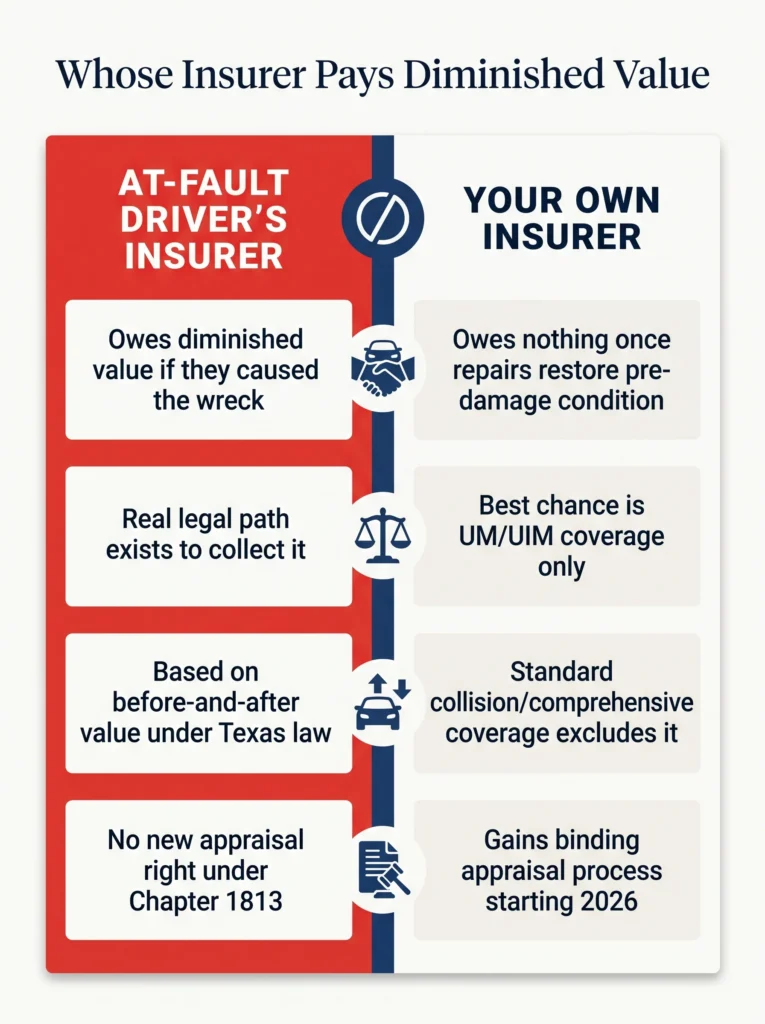
Which claim you have depends on who caused the wreck. If another driver hit you, you can file a claim against their insurer for your car’s diminished value, and Texas gives you a real path to collect it.
If you’re going through your own insurer instead, the rules tighten. Texas Department of Insurance guidance says your own insurer doesn’t owe you diminished value once your car is properly repaired back to its pre-damage condition under ordinary collision or comprehensive coverage.
Your best shot at diminished value from your own carrier is through your uninsured or underinsured motorist coverage, which can pay it regardless of how complete the repair was.
How Insurers Value Your Totaled Car
Sometimes the damage is bad enough that repairing your car isn’t the question anymore. Under Texas Transportation Code § 501.091, your car counts as a salvage motor vehicle when the covered repair costs exceed the vehicle’s cash value prior to the accident.
Here’s the part that catches people off guard: Texas doesn’t require insurers to use one specific method to land on that actual cash value. Insurers typically lean on valuation software and published used-vehicle pricing guides, adjusted for your car’s condition, mileage, and equipment, but no single approach is required by law.
That flexibility is exactly why two people can run the same car through two different tools and get two different numbers. It’s also why a first offer on a totaled car is worth a second look before you sign off on it.
The 17c Diminished Value Formula
You may see your diminished value offer built from something called the 17c formula. The name comes from a paragraph in the settlement that followed State Farm Mutual Automobile Insurance Co. v. Mabry, a 2001 Georgia class-action case that forced insurers to actually evaluate diminished value instead of ignoring it.
Texas courts never adopted that case, and no Texas law requires any insurer in the state to use the resulting formula.
The formula itself starts by capping your maximum possible loss at a small slice of your car’s pre-loss value, then shrinks that number twice more: once for how severe the repaired damage was, and again for your car’s mileage. Two reductions stacked on a low starting cap tends to land well below what your car actually lost in resale value, especially after structural or safety-system repairs.
Because it’s an insurer’s internal estimating tool they may decide to use and not an official rule Texas requires, a 17c number is a starting offer, not a final answer.
How to Document and Support Your Claim
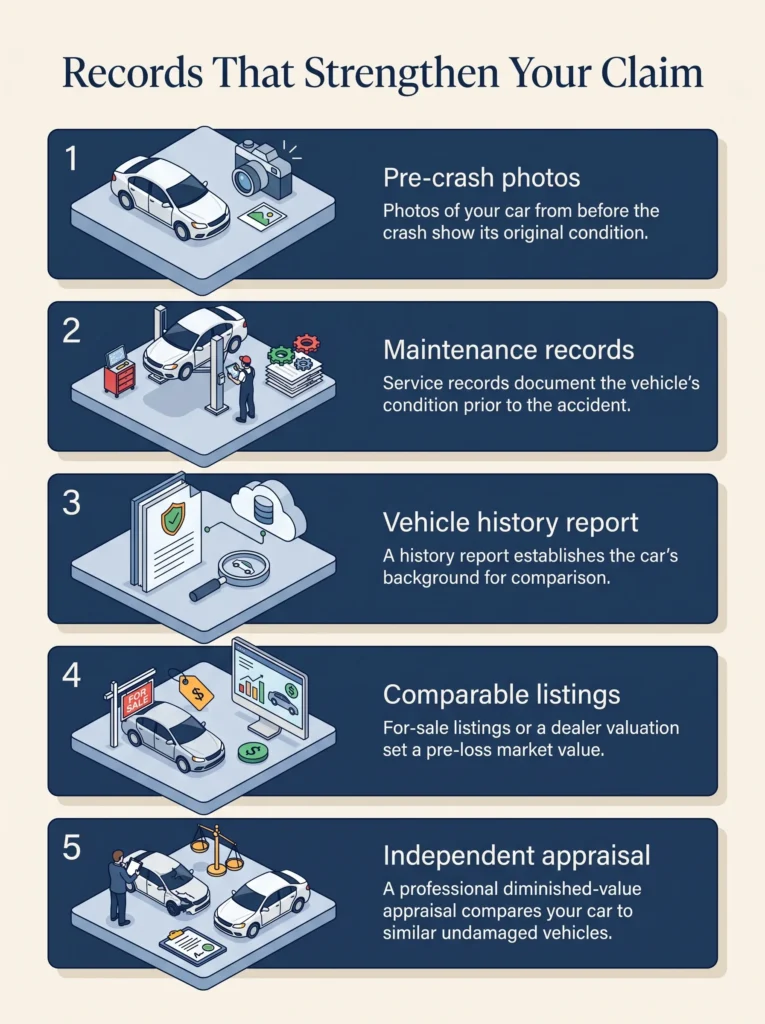
Whether you’re negotiating a diminished value claim or fighting a low total-loss number, the strongest move is proof the insurer can’t wave away. Useful records to gather include:
- Photos of your car from before the crash
- Maintenance and service records showing its condition
- A vehicle history report
- Comparable for-sale listings or a dealer valuation from before the loss
- A professional diminished-value appraisal that compares your repaired car to similar undamaged vehicles
That last item carries real weight. An independent appraiser has no stake in what your insurer pays, so a report built on comparable vehicles is hard to dismiss as a bargaining position.
You now have another lever, too. Starting September 1, 2025, and applying to personal auto policies issued or renewed in Texas on or after January 1, 2026, Texas Insurance Code Chapter 1813 requires your own policy to include an appraisal process for disputes over the dollar amount of a loss.
You pick an appraiser, your insurer picks one, and if the two can’t agree, they bring in a neutral umpire. The resulting award binds both sides unless there’s fraud, an accident, or a material mistake in how it was reached. This right runs with your own policy, so it applies to a dispute with your own insurer, not a way to force an appraisal out of the at-fault driver’s carrier.
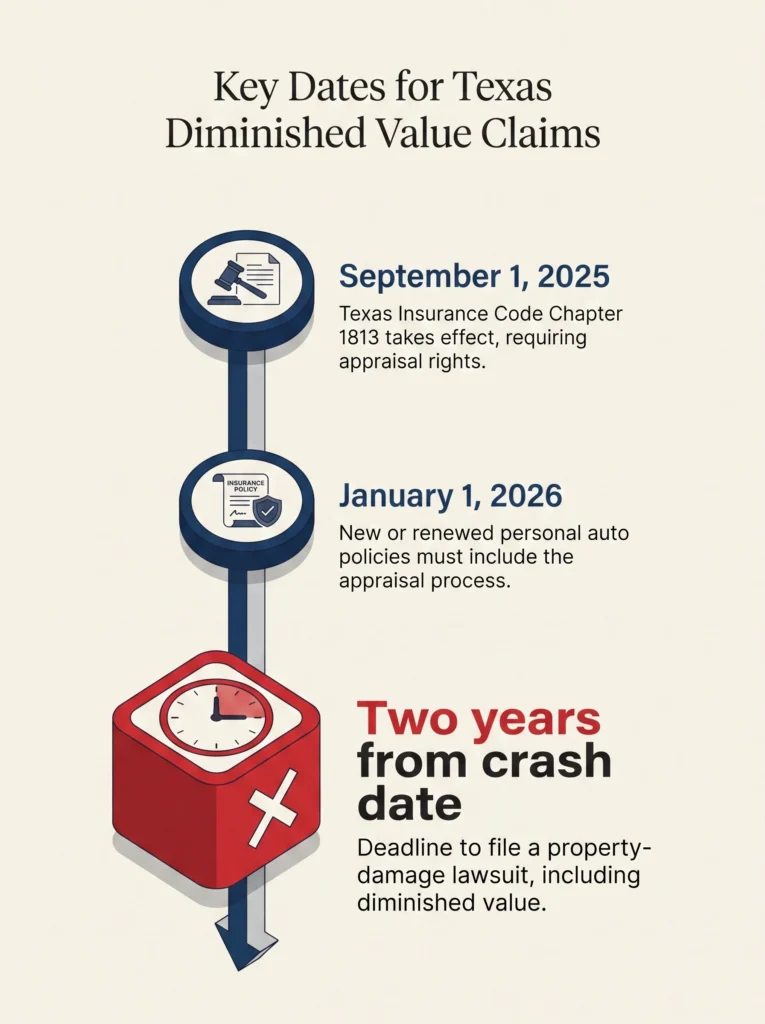
One more date to keep in mind: Texas gives you two years from the date of the crash to file a property-damage lawsuit, including a diminished value claim. That’s a legal deadline, not how long the claims process itself should take, so start documenting your loss well before it gets close.
When to Bring In an Attorney
A diminished value claim gets complicated when a crash leaves you hurt, not just your car. In that case, an attorney handling your injury claim can typically fold the property claim, diminished value included, into one overall claim against the at-fault driver’s insurer instead of you juggling two separate fights at once.
Texas Crash Network can match you with an attorney who can handle a claim like yours. Matching is free, and you pay no attorney fees unless your attorney wins. If you’re not ready for that yet and just have questions, you can also reach out to TCN directly.