
You have a settlement offer in hand, or you’re trying to decide whether to accept one, and you can’t quite tell if it’s fair or just fast. That’s the real question behind hiring a lawyer: not whether an attorney sounds expensive, but whether the number in front of you accounts for everything your crash actually cost you.
Do Lawyers Get Bigger Settlements?
The insurance industry’s own researchers say so, and they aren’t happy about it.
The Insurance Research Council reviewed more than 7.4 million auto injury claims closed between mid-2017 and mid-2022, and named increasing attorney involvement and litigation as one of the forces pushing claim costs higher.
Read that from your side of the table: claims with an attorney cost insurers more money. With that context, it’s easy to see why insurers are quick to shove an offer in front of you in hopes that you sign it before having a lawyer review your case.
The study pointed at general damages as the amplifier, meaning the part of your settlement that isn’t a medical bill. Your bills come with receipts attached. Your pain, your missed work, and the treatment your doctor says is still coming don’t. That part has to be documented and argued before an insurer pays a dollar toward it.
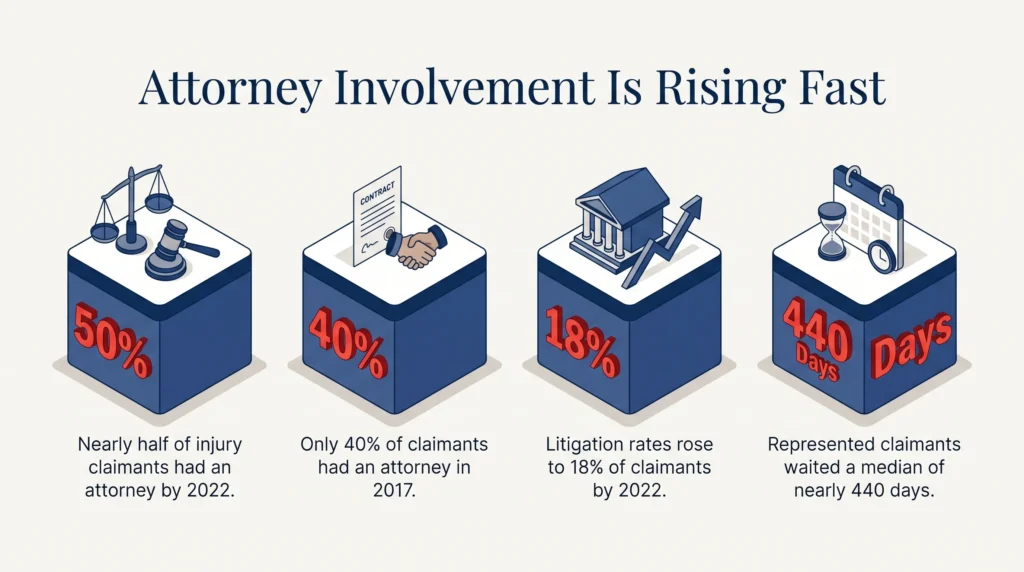
Recently, claimants have been working that out. Nearly half of injury claimants had an attorney by 2022, up from 40% in 2017, and litigation rates nearly doubled over the same years, from 10% of claimants to 18%. That’s largely thanks to the diligent work of attorneys who have refined strategies for getting results.
Why a Represented Claim Takes Longer
Claims with an attorney do take longer to close. In that same data, represented bodily injury claimants waited a median of nearly 440 days, more than double the wait for claimants handling their own.
Insurers would love for that fact to convince you that you don’t need representation, but the reality is that extra time is a good thing.
An attorney’s goal is to get your claim paid at full value as soon as its full value is known. Two things set that timeline, and neither is your attorney’s choice. The first is medical. Your doctor can’t say what future treatment you’ll need until your recovery starts to take shape. Everyone recovers at different rates and similar injuries may still need differing levels of ongoing care. Until that can be adequately determined, nobody knows what your claim is worth, including you.
The second is the insurer. An insurance company is a business, and every dollar it pays on your claim is a dollar off its books. Small claims get processed. Larger ones get examined, and the more your claim is worth, the more detailed that examination gets.
Scrutiny costs time. The insurer asks for more records. They could question whether a treatment was necessary, or whether your injury really came from this crash and not something earlier. Answering that can take another specialist’s opinion, another set of records, and another round of letters. Every point the insurer disputes is a point your attorney has to go document and prove, and information the insurer controls tends to arrive on the insurer’s schedule.
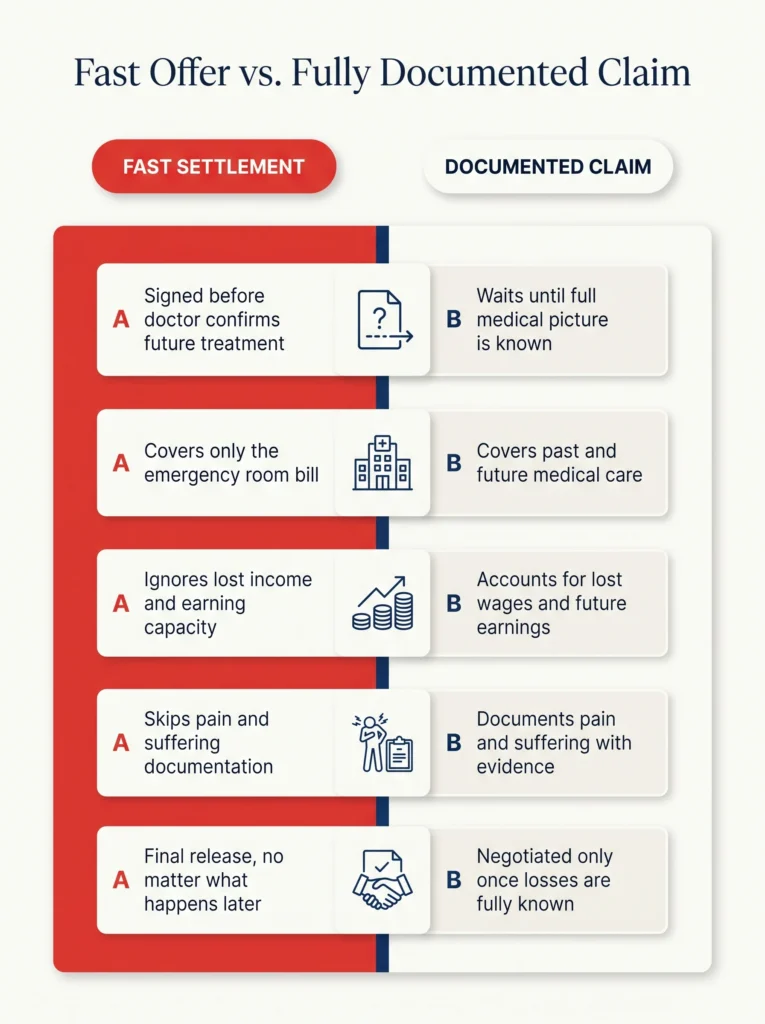
None of that happens if you take the first offer. A fast settlement is the cheap settlement, and it’s available to anyone willing to accept less. Texas Department of Insurance guidance lays out how that works: the at-fault driver’s insurer will offer you a settlement and ask you to sign a release, giving up your right to file any more claims for your crash.
Once you sign, it’s final, even if a new symptom shows up next month. An offer that closes in 60 days never has to account for a surgery you didn’t know you’d need.
So when that IRC data shows represented claimants waiting a median of nearly 440 days, more than double the unrepresented wait, read it for what it is. Represented claims are the ones with disputed fault, serious injuries, and thin coverage. Those were going to be a fight either way. The same report treats rising claim payouts as an affordability problem for insurers, which tells you plainly which direction their incentive runs.
With an attorney, none of that extra stress lands on you. The records requests, the adjuster’s calls, deadlines, and the paperwork that shows up at the worst possible moment; your attorney absorbs all of it while you go to your appointments.
What a Contingency Fee Costs You
Nothing up front. Most personal injury attorneys work on a contingency fee, typically one-third to 40% of what you recover, according to the American Bar Association. That percentage comes out of money you win. If your claim doesn’t result in a payment, you don’t owe your attorney for the hours they put in.
All of the attorneys we work with here at Texas Crash Network operate on this fee structure.
The part worth asking about is case costs, which include things like medical records requests and expert reports. Some fee agreements subtract those costs before the percentage gets calculated, and some subtract them after. That difference changes what you take home, and any attorney should walk you through it before you sign.
What a Good Attorney Does With That Time
The real work happens before any release gets signed. A thorough attorney holds off until your doctor has weighed in on the treatment you might still need, because that’s exactly the information TDI says you should use to judge whether an offer is fair.
Complete documentation also means pricing your claim on more than the emergency room bill. A full accounting generally covers:
- Medical care you’ve already had, plus treatment you’re reasonably likely to need later
- Lost income from time away from work, and reduced future earning capacity if your injury is disabling
- Damage to your vehicle and your other property
- Pain and suffering tied to an injury that’s documented, not guessed at
Negotiation comes last, and it takes discipline in both directions. A good attorney won’t take the first number before your losses are known. They also won’t pile on treatment you don’t need just to pad a bill. Knowing which of those columns is worth pushing on, and what an insurer will actually pay for it, is the expertise you’re buying.
That’s the difference between a claim that gets valued and one that just gets processed.
Why Texas Fault Rules Raise the Stakes
In Texas, the percentage of fault an insurance adjuster assigns you isn’t a fixed fact. It’s a negotiated conclusion, and it decides how much of your claim you actually get to keep.
Under Texas Civil Practice and Remedies Code § 33.001, you can’t recover anything if you’re found more than 50% responsible for the crash. Below that line, whatever you’d otherwise recover gets reduced by your own percentage of fault. A few contested points, argued with evidence, can be the difference between a real payment and none at all, or between a partial recovery and a full one.
Texas also requires the at-fault driver to carry at least $30,000 per person and $60,000 per accident in liability coverage, so there’s a real, but limited, pool of insurance money any negotiation draws from. That’s part of why full investigation and complete damage documentation aren’t optional extras. They’re what backs up your side of a fault argument that has real money attached to it.
Let TCN Match You With an Attorney
You don’t have to work out fault percentages, damage categories, or release language on your own. Texas Crash Network can match you with an experienced attorney who already knows how to build a complete claim, and the match itself costs nothing. You pay no attorney fees unless the attorney who takes your case recovers money for you, the same no-win, no-fee model most personal injury attorneys use.
Take our short survey and we’ll match you with the right attorney for your situation. If you have questions first, reach out to Texas Crash Network before you decide anything.