You’re looking for a number that tells you how much your claim is worth. Real ones exist, not on a law firm’s highlight reel, but in Texas court records, where a jury already put a dollar figure on someone else’s pain, and the appeals court record shows exactly why that jury landed where it did.
How to Read These Texas Verdicts
Almost every real pain-and-suffering settlement in Texas is confidential. No registry publishes what an insurer actually paid, and a firm’s own advertised number isn’t something you can check. In fact, a good number of these settlements also include non-disclosure language that prevents either side from talking about the matter publicly.
That can make it hard to find actual, tangible data to base your research around. So where do you start? What you can check is a jury verdict: a real Texas case where a jury heard the evidence, put a dollar figure on the claimant’s pain, and an appeals court then reviewed whether that figure held up. The three cases below are that kind of record: real, cited, and verifiable, not confidential settlement data you have no way to check.
This page was last reviewed in August 2026. Every case below is illustrative, not a prediction. A different injury, a different record, or a different jury can reach a different number, sometimes a very different one, for reasons the next two sections walk through.
Three Real Texas Verdicts, Zero to Moderate
These three cases span the real range, from the claimant receiving nothing to a moderate five-figure sum; the difference comes down to the evidence, not how the injury felt to the person living it.
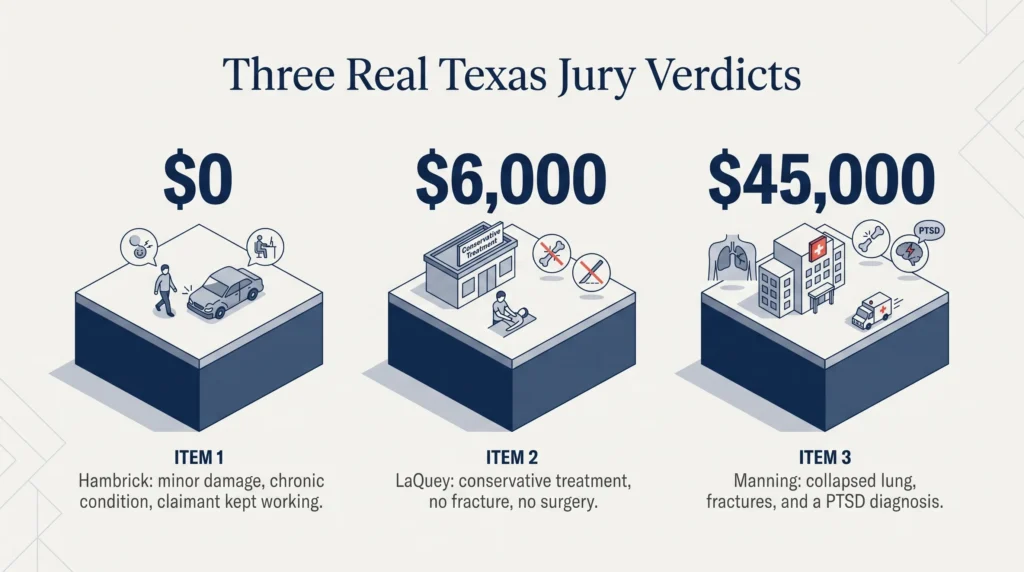
- $0. In Hambrick v. Foremost County Mutual Insurance Co., a hit-and-run driver struck the side of the claimant’s car in a low-speed collision in Cherokee County. He asked the jury for up to $400,000 in past and future pain, mental anguish, and impairment. The jury awarded nothing, and the court of appeals affirmed it: the car showed only minor damage, medical testing pointed to a chronic condition rather than a new injury, and he kept working the entire time.
- $6,000. In LaQuey v. Cox, a Tarrant County collision left the claimant with low back and radiating lumbar pain, treated conservatively with no fracture and no surgery. The jury awarded $6,000 for pain already suffered and nothing for pain still to come. She appealed the zero future-pain award; the court of appeals affirmed it anyway, since a subjective, fully-resolved injury like hers falls within the jury’s discretion to weigh however it sees fit.
- $45,000. In Manning v. Golden, a collision left the claimant with a collapsed lung that needed a chest tube, a broken nose, facial cuts, heavy bruising, and a PTSD diagnosis from her treating doctor. The jury awarded $40,000 for past physical pain and mental anguish and $5,000 for the future, $45,000 total inside a larger judgment. She argued on appeal that the number was too low, but the court of appeals left it exactly where the jury put it.
All three arose from Texas car accident claims, and all three moved through a real courtroom, not a negotiating table. That’s what makes them checkable.
How These Numbers Get Built
Attorneys and adjusters usually rely on one of two methods to calculate a pain-and-suffering figure from documented losses: the multiplier method and the per diem method.
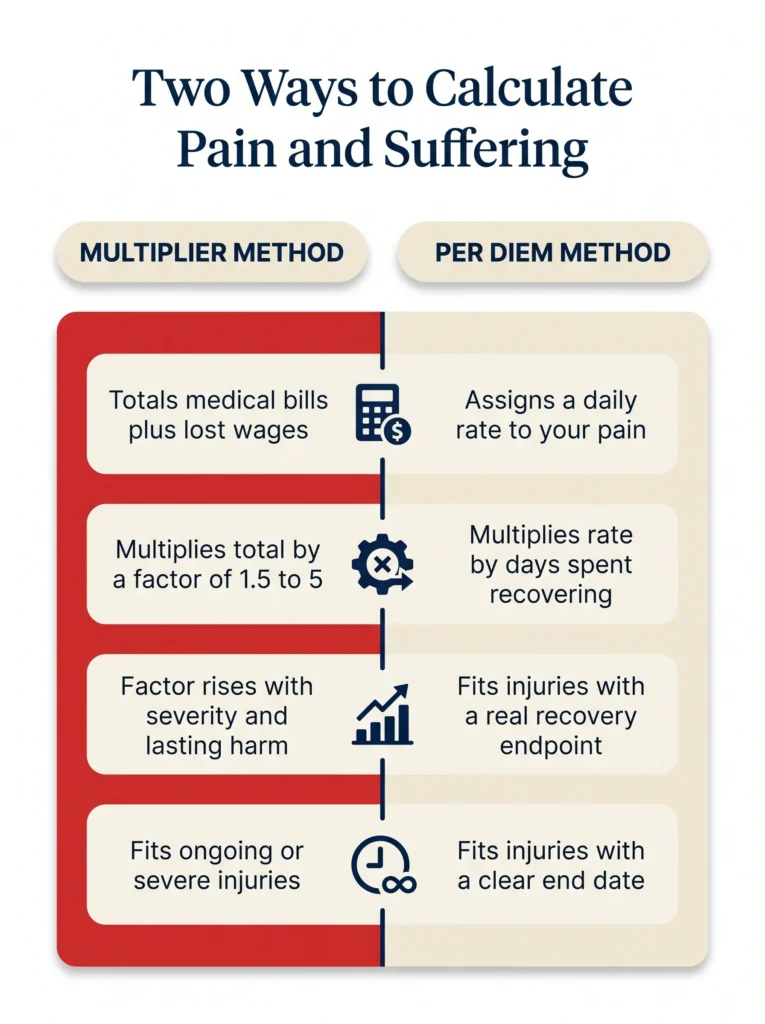
The multiplier method totals your economic damages, medical bills plus lost wages, and multiplies that total by a factor, usually somewhere between 1.5 and 5 depending on how severe and lasting the injury is, a range FindLaw’s consumer guide to the multiplier method walks through in detail. A fully-resolved back injury like LaQuey’s sits near the bottom of a range like that. A collapsed lung, facial fractures, and a diagnosed psychological condition, like Manning’s, sit much higher, because the record behind it was so much more objective and severe.
The per diem method works differently. It assigns a daily rate to your pain, then multiplies that rate by the number of days you spent recovering, which fits an injury with a real endpoint better than it fits something ongoing.
Both methods only work as well as the documentation behind them. Under Texas Civil Practice and Remedies Code (CPRC) § 18.001, you can lock in that your medical bills were reasonable and necessary through a sworn affidavit from your provider, without dragging an expert into court, unless the other side challenges it in time. A demand built on records like that, and pointed at real, cited verdicts instead of a guess, changes the conversation with an adjuster; it stops being an open question and becomes a number they have to answer.
What Moves Your Number Up or Down
None of the three verdicts above tells you what your case is worth, and there’s a legal reason for that. In Gregory v. Chohan, the Texas Supreme Court threw out a jury’s noneconomic damages award of more than $15 million because the evidence never established a rational connection, grounded in the record, between the harm and the dollar figure. A big number from a sympathetic jury isn’t enough on its own, which is why every case has to earn its own number from its own record, and why one claimant’s verdict can’t forecast another’s.
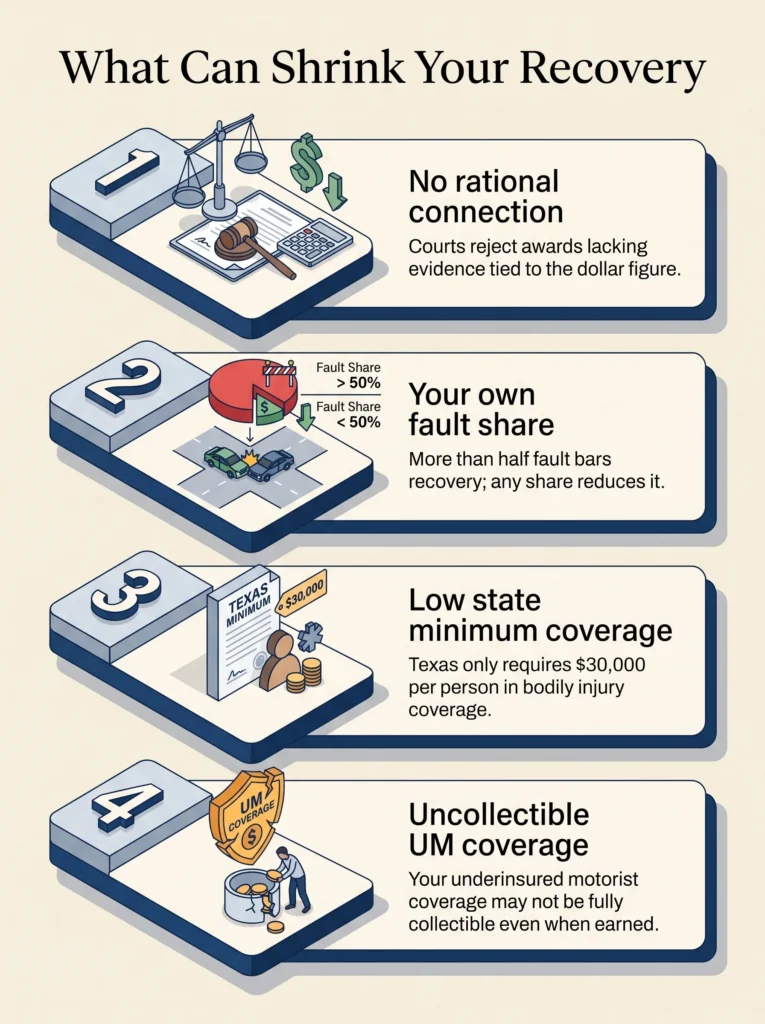
Two other forces can shrink a well-documented number before you ever collect it:
- Texas CPRC § 33.001: If you’re found more than half responsible for the crash, you recover nothing, and any recovery you do get shrinks by your own share of the fault.
- Texas Transportation Code § 601.072: Texas only requires a driver to carry $30,000 per person and $60,000 per accident in bodily injury coverage. This is a strong, well-documented number that outruns the at-fault driver’s actual policy, and your own underinsured motorist coverage may not be fully collectible even when it’s fully earned.
Get Matched with the Right Attorney
Getting a real number like Manning’s, backed by objective evidence and treatment, or avoiding a zero like Hambrick’s, takes more than picking a multiplier off a chart; it takes a case built the right way from the start. Texas Crash Network handles the search for you, connecting you with an attorney who knows how to build a demand from real evidence and real comparable outcomes, not guesswork.
Take our short survey to get matched with the right attorney for your specific situation. Matching is free, and you pay no attorney fees unless your attorney wins. If you have questions first, you can always reach out before you decide anything.
We provide support in English and Spanish.