
Your medical bills tell the insurance company what your treatment cost. They don’t say anything about the pain itself, the nights you couldn’t sleep, or the drive you now dread every time you get behind the wheel. Texas law lets you put a number on that too, and two methods do most of the real work.
How Pain and Suffering Is Calculated
Texas doesn’t hand adjusters a formula written into law. Instead, attorneys and insurance adjusters lean on two established approaches to turn your documented losses into a pain and suffering figure: the multiplier method and the per diem method. Which one fits depends on your injury, whether it resolved on a knowable timeline or left something permanent.
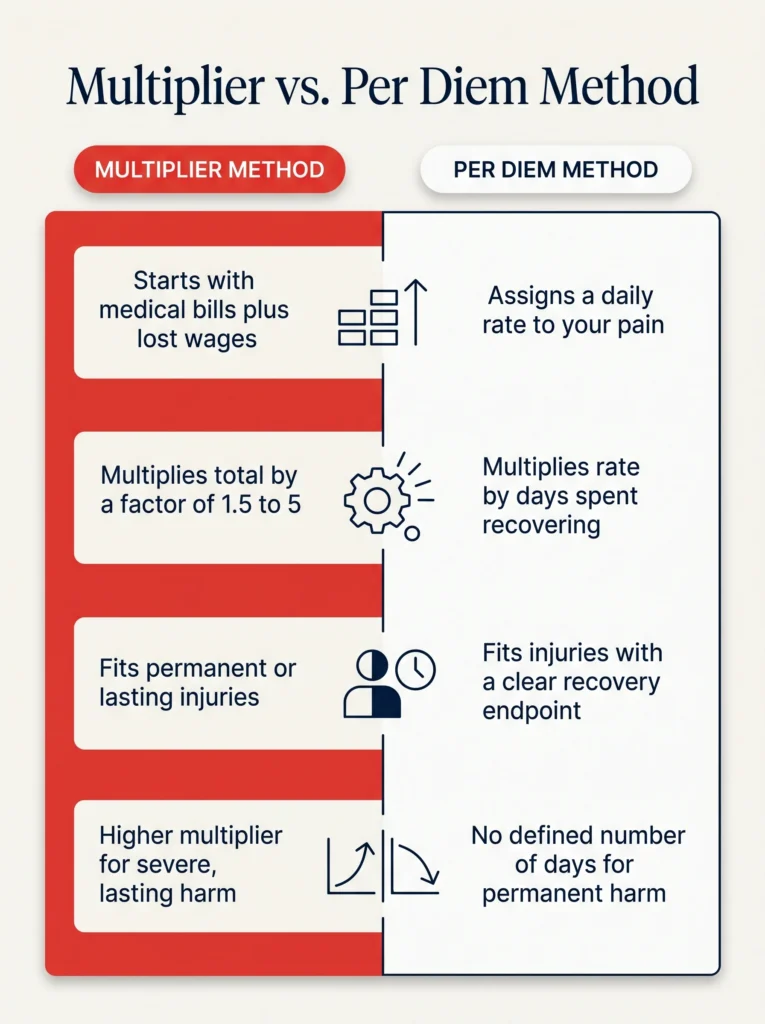
The Multiplier Method
The multiplier method starts with your economic damages: your medical bills plus any wages you lost, added together into one total. That total gets multiplied by a factor, usually somewhere between 1.5 and 5 depending on how severe and how lasting the injury is, a range FindLaw and other claims-industry sources commonly cite.
A strained back that clears up in six weeks sits near the bottom of that range. A fracture that leaves permanent limits, or an injury that changes how you move for good, sits near the top.
Here’s how the math plays out. Say a Texas car accident claim leaves you with $12,000 in medical bills and $3,000 in lost wages, for $15,000 in economic damages. If your injury and recovery time support a multiplier of 3, the pain and suffering component would come to $45,000, on top of the $15,000 in bills and wages.
That’s illustrative math, as every claim is different. Your actual number depends on your specific injury and the evidence behind it.
The Per Diem Method
The per diem method works differently. Instead of multiplying your total bills, it assigns a daily rate to your pain and suffering, then multiplies that rate by the number of days you spent recovering. This approach tends to fit an injury with a clear endpoint, one you healed from in a set number of weeks or months, better than it fits a permanent condition, where there’s no defined number of days to count.
Does Texas Cap Pain and Suffering?
No. In an ordinary car accident claim, Texas puts no statutory limit on what you can seek for pain and suffering, mental anguish, or physical impairment. You may have heard that Texas caps damages, and it does, but only for a different kind of claim.
That cap lives in Texas Civil Practice and Remedies Code § 74.301, and it applies to health care liability claims, cases built around medical negligence. A car accident is an ordinary negligence claim, so this cap doesn’t reach it.
Texas does cap punitive damages separately, but that sits in its own category. Punitive damages punish especially reckless conduct, like fraud or gross negligence, and require their own proof beyond what an ordinary negligence claim needs. Your pain and suffering is a compensatory damage, not a punitive one, and the two stay on separate tracks.
Proving Your Pain and Suffering Claim
Both methods are only as strong as the foundation under them. Before a multiplier or a daily rate means anything, your medical bills and lost wages need to hold up as documented, reasonable, and necessary.
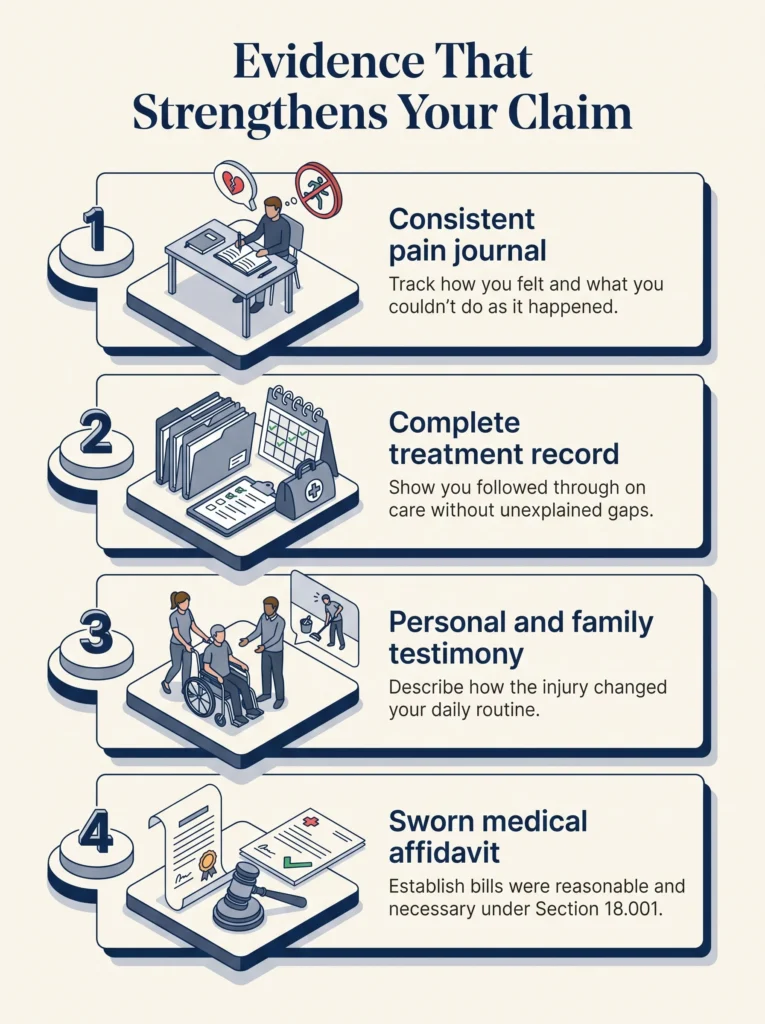
Under Texas Civil Practice and Remedies Code § 18.001, you can lock that in with a sworn affidavit from your provider or their records custodian: an itemized statement of each service and charge that establishes your bills were reasonable and necessary, without dragging an expert into court, unless the other side files its own timely challenge.
Your economic damages aren’t limited to what you’ve already paid, either. If your injury calls for care down the road, or it changes your ability to earn what you used to, that future loss belongs in the total too, as long as you can show it’s reasonably probable and reasonably priced, the standard
Texas courts apply under Rosenboom Mach. & Tool, Inc. v. Machala. Future care and diminished earning capacity are real economic losses that belong in your specials total, right alongside your medical bills and lost wages.
Beyond the bills, the evidence that actually moves an adjuster shows what the injury cost you day to day:
- A pain journal that tracks how you felt and what you couldn’t do, kept consistently rather than reconstructed later.
- A treatment record without unexplained gaps, showing you followed through on care.
- Your own account, and sometimes a family member’s, of how the injury changed your routine.
This is where a good attorney helps by building the specials correctly and presenting that corroborating evidence in a form an adjuster takes seriously, instead of a stack of bills with no story behind them.
How Fault and Coverage Can Affect Your Payout
A well-documented number can still shrink once fault and insurance enter the picture. Under Texas Civil Practice and Remedies Code § 33.001, Texas follows a proportionate-responsibility rule: if you’re found more than 50% responsible for the crash, you do not receive compensation. If you are less than 50% responsible for the crash, any recovery you do get is reduced by your specific percentage of fault.
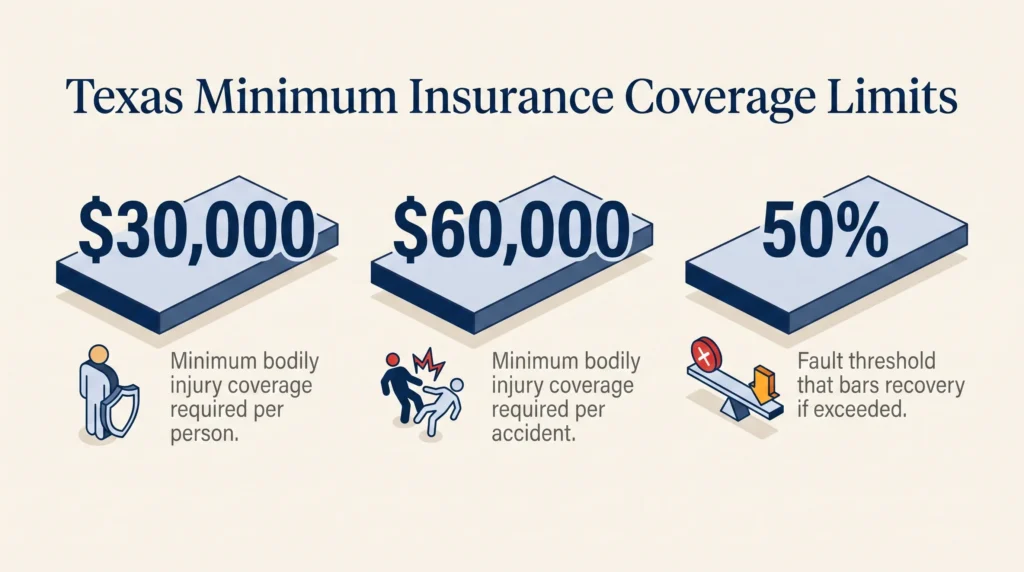
Insurance sets a separate, practical ceiling. Under Texas Transportation Code § 601.072, Texas requires drivers to carry at least $30,000 in bodily injury coverage per person and $60,000 per accident. Even a well-supported pain and suffering figure runs into the at-fault driver’s actual policy limits, or your own underinsured motorist coverage, once it’s time to collect.
Coverage decides what’s actually collectible, separate from the legal question of whether a cap applies.
Get Matched With the Right Attorney
Getting this right takes more than picking a multiplier. It takes an eye for which method fits your injury and the patience to put real evidence behind it. Texas Crash Network can connect you with an attorney who can handle a claim similar to yours. Take our short survey and we’ll match you with the right attorney.
Matching is free, and you pay no attorney fees unless your attorney wins. If you have questions first, you can always reach out before you decide anything.