
You typed “knee injury settlement calculator” into the search bar because you wanted to know specifically how much your case is worth. The reality is that no calculator can provide an accurate estimate because the value of your case depends on your specific diagnosis, your treatment plan, and your doctor’s opinion on what will happen to your knee in the future.
The good news is that these are hard facts you can find out and document to prove the value of your case.
Knee Injury Value Depends on These Factors
There is no reliable average settlement amount or calculator that can accurately predict the value of your knee injury claim. Instead, your claim’s value depends on the specific facts of your case, including:
- Which part of your knee was injured
- The severity of your injury
- Whether you needed surgery
- Your doctor’s opinion on possible long-term limitations or future arthritis
- Your past and future medical costs and lost income
- How clearly the evidence links your injury to the crash
- Whether your share any fault for the crash
- How much insurance coverage is available to pay your claim
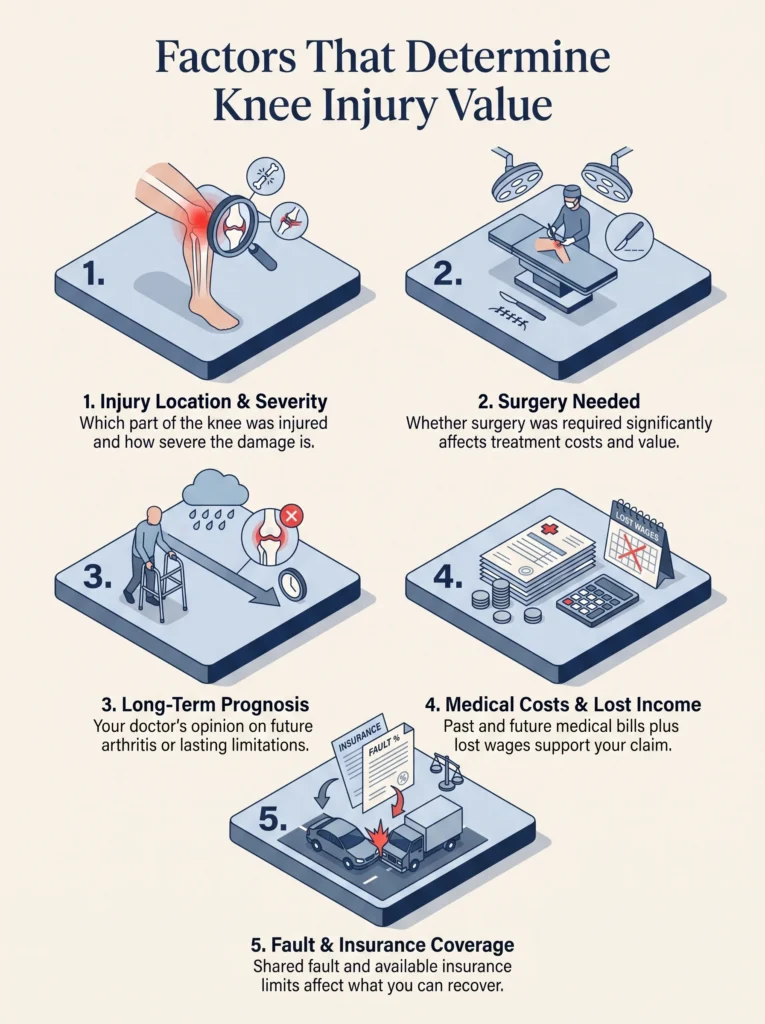
Claim values are based on the evidence that supports your treatment record, not a fixed formula. This is why two claims with the same diagnosis can have very different values once the severity of the injury, medical documentation, and percentage of fault are considered.
ACL Tears, Meniscus Tears & Patella Fractures
If your knee slammed into the dashboard or center console, then you probably injured one of three structures:
- ACL
- Meniscus
- Patella
Each of these structures has its own treatment path and documented costs in a car accident injury claim. That’s why identifying the specific structure that was injured is important to determine the actual value of your claim
ACL Tears
Your ACL is the ligament that keeps your knee from rotating or sliding too far forward. According to the American Academy of Orthopaedic Surgeons, it is one of the structures most often torn in a car crash. Some tears heal well with bracing and physical therapy to rebuild the muscles around the knee. Others need surgical reconstruction to restore stability to the joint.
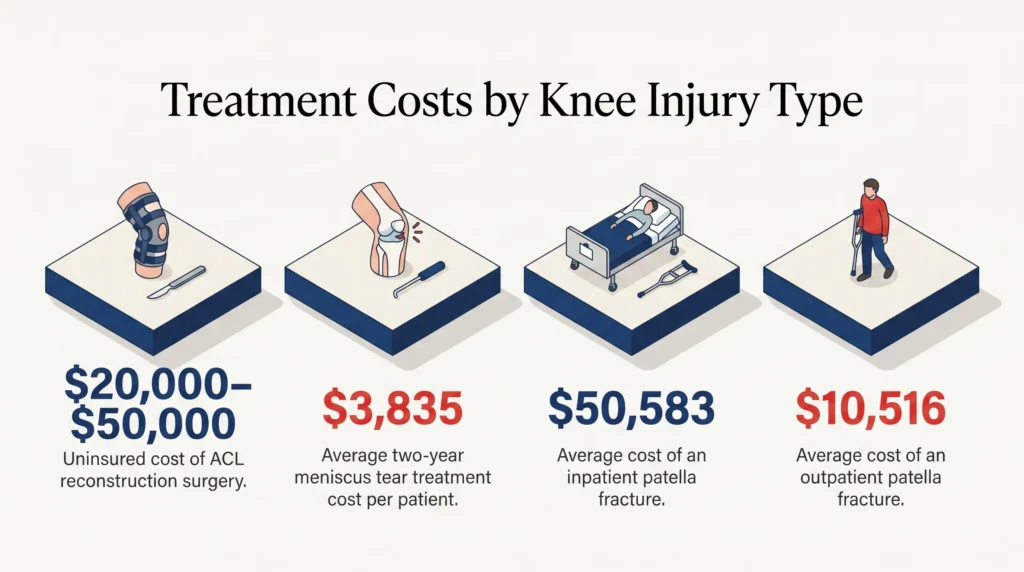
Treatment costs typically reflect the severity of the injury. Without insurance, ACL reconstruction typically costs $20,000 to $50,000, which pays for the surgeon, hospital or surgical facility, anesthesia, and graft used to repair the ligament. With insurance, most patients pay closer to $800 to $3,000 out of pocket for the same surgery. Medical expenses are only one factor, but they are a documented portion of the losses that you can recover in your claim.
Meniscus Tears
Your meniscus is a piece of cartilage that cushions your knee and helps it carry your weight evenly. It can tear easily when your knee twists suddenly during a crash. Depending on the location of the tear and whether it has an adequate blood supply to heal itself, treatment ranges from physical therapy to arthroscopic repair surgery or partial removal of the damaged cartilage.
A 2024 study in the Orthopaedic Journal of Sports Medicine tracked actual treatment costs for meniscus tears and found that average treatment costs over a two-year period were $3,835 per patient. This ranged from $1,905 per patient if no surgery was needed to $7,649 per patient if surgery was needed later. These figures reflect medical treatment costs, not settlement values, but they illustrate how the course of treatment can affect your claim’s overall value.
Patella Fractures
According to the American Academy of Orthopaedic Surgeons, the patella (or kneecap) is the most commonly broken bone around the knee in high-impact crashes. A stable fracture may heal in a brace or cast, while a displaced or complex break usually requires surgical repair with pins, screws, or wires to hold the bone in place while it heals.
A 2018 study in Value in Health on commercial insurance claims found that the average adjusted cost of a patella fracture was $50,583 treated as an inpatient versus $10,516 treated as an outpatient, depending mainly on whether surgery was needed. These figures reflect healthcare costs reported through insurance claims, not settlement values, but they illustrate how treatment can significantly affect the value of your injury claim.
Future Medical Costs and Lost Income
Your knee injury claim isn’t limited to the medical bills you’ve already paid. It also includes future medical care and any diminished ability to earn income, if these losses can be proven with medical and vocational evidence.
Future Medical Costs
A documented prognosis showing long-term instability, future arthritis, or a probable second surgery can help prove your claim’s value.
Studies following ACL injuries found that roughly 78% to 83% of patients showed signs of post-traumatic arthritis 10 to 14 years after the injury, particularly when the injury also involves a torn meniscus, which is one of the strongest predictors of long-term arthritis after an ACL injury, according to the Arthritis Foundation.
Lost Income
Lost income includes more than the wages you have already missed. If a lasting knee injury limits your ability to perform your job or reduces your future earning potential, you may also be able to pursue compensation for these economic losses. Claims for future medical care and diminished earning capacity must be supported by medical evidence (including your treating doctor’s records and imaging) to connect your injury to your crash.
Fault, Insurance, and Filing Deadlines
How Texas Comparative Fault Rules Affect Your Recovery
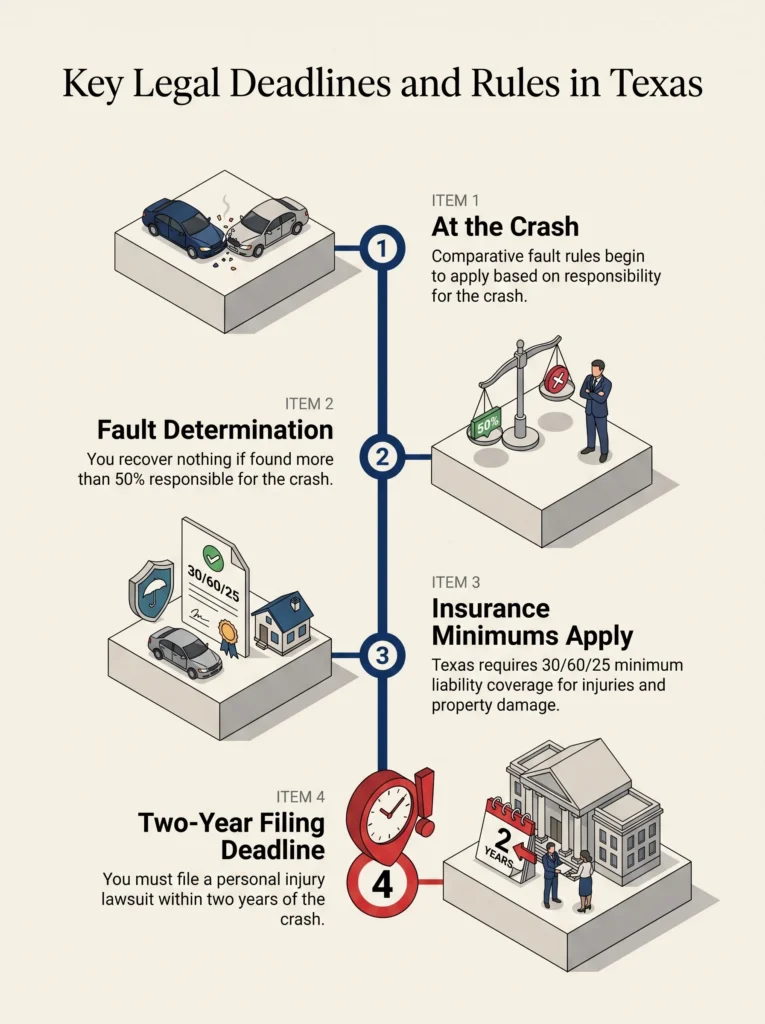
Texas follows a proportionate responsibility rule that can significantly change the amount you recover. Under Texas Civil Practice and Remedies Code § 33.001, you recover nothing if you’re found more than 50% responsible for the crash. If you are found 50% percent or less responsible, then you can still recover compensation, but your award is reduced by your percentage of fault.
How Insurance Limits Affect Your Recovery
The amount of available insurance also limits what you can actually recover. Texas Transportation Code § 601.072 requires minimum auto liability coverage of $30,000 per person and $60,000 per accident for injuries, plus $25,000 for property damage (commonly known as “30/60/25” coverage). An ACL tear or patella fracture that requires surgery can cost more than the $30,000 minimum on its own, which is why your own underinsured motorist coverage is worth checking into, rather than only relying on the at-fault driver’s policy.
The Texas Two-Year Filing Deadline
Under Texas law, you also have a deadline of two years from the date of the crash to file a personal injury lawsuit. Missing this deadline usually means losing the right to sue at all, so it is important to gather and document your medical treatment and supporting evidence as quickly as possible.
Find the Right Attorney for Your Claim
You don’t have to evaluate diagnosis codes, treatment costs, and fault percentages by yourself. Texas Crash Network can match you with the right attorney for your knee injury claim. Our attorneys know how to review your specific diagnosis, document your surgery, and secure a prognosis for future arthritis or supplemental surgeries. Our matching service is free, and you pay no attorney fees unless the attorney wins your case.
Reach out to Texas Crash Network to discuss your options today.