The other driver hit you, but they never stopped to exchange information. Now they’re nowhere to be found, and you’re wondering who pays for any damages. Texas law gives you a real path to recovery, even without a name or insurance card from the driver who fled. You can use your own insurance, and it doesn’t require you to ever track down the other driver.
Hit-and-Run Claim Value Depends on These Factors
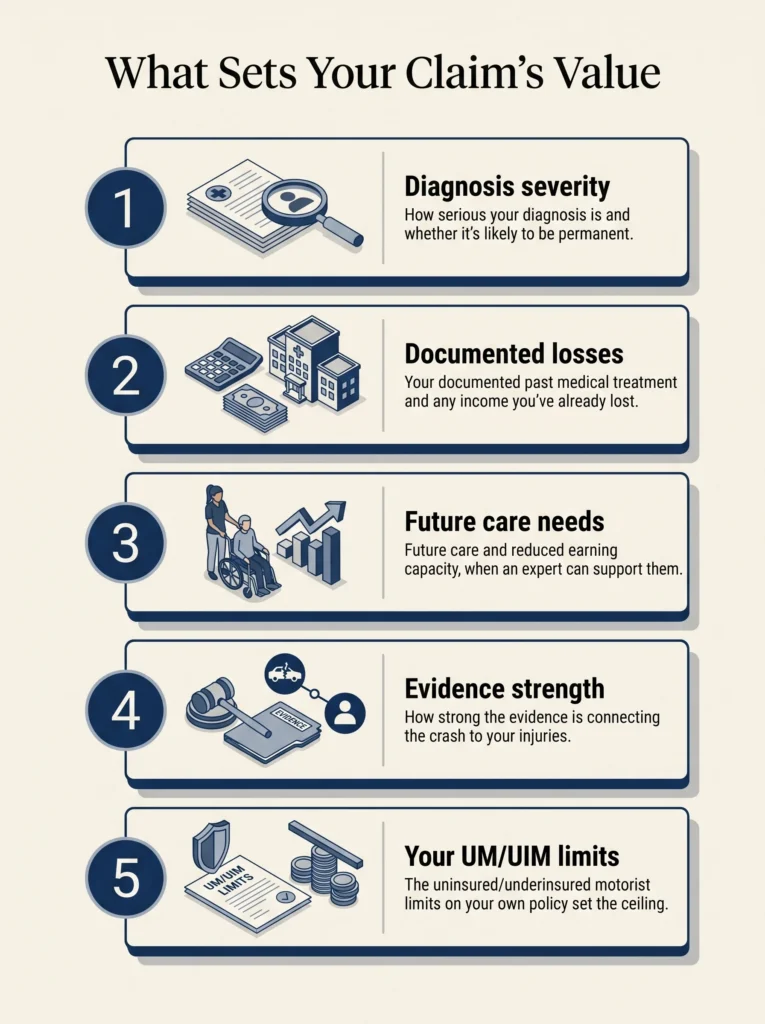
There’s no real “average hit-and-run settlement” number. Private settlements aren’t tracked in any public database, and a number pulled from a law firm’s marketing page isn’t a real source. The only honest answer is what actually sets the value of your specific claim:
- How serious your diagnosis is and whether it’s likely to be permanent.
- Your documented past medical treatment and any income you’ve already lost.
- Future care and reduced earning capacity, when a doctor or vocational expert can support them.
- How strong the evidence is connecting the crash to your injuries.
- The uninsured/underinsured motorist (UM/UIM) limits on your own policy.
That last factor is what makes a hit-and-run different from an ordinary crash claim. There’s no at-fault driver’s insurance to negotiate against, so your own UM/UIM limits become the ceiling on what your claim can pay, no matter how strong your medical case is.
Hit-and-run crashes are more common than many drivers assume. In 2023, about 15% of all police-reported crashes involved a driver who left the scene, according to the AAA Foundation for Traffic Safety. That’s a national figure, not a Texas-specific one, but it shows you’re far from alone in dealing with this.
Hit-and-Run Payouts Usually Come from Your Own Policy
Since the driver who hit you can’t be billed, your recovery usually runs through your own insurance instead of a claim against theirs. Texas requires UM/UIM coverage on nearly every auto policy unless the policyholder rejected it in writing, under Insurance Code § 1952.101. A driver who fled the scene and can’t be identified counts as a UM for that coverage.
The usual process for a Texas car accident claim assumes there’s another driver’s insurance to work with. A hit-and-run swaps that process for a claim against your own insurer instead.
One Texas rule matters most here: when the driver who caused your injury is unknown, actual physical contact must have occurred between that driver’s vehicle and you or your car before UM coverage applies, under Insurance Code § 1952.104. There isn’t much room around this requirement. What a witness, nearby video, or the police report can do is prove that contact with an unidentified vehicle actually happened when it’s in question, not replace a contact that never occurred. A direct hit has a much clearer path to coverage than a no-contact swerve.
Texas also requires personal injury protection (PIP) coverage, at a minimum $2,500 benefit. This is included in most auto policies unless it was rejected in writing, under Insurance Code § 1952.152. PIP pays your own medical bills and part of your lost income on a no-fault basis. It doesn’t matter who caused the crash or whether the fleeing driver is ever found, which makes it the fastest layer of recovery available while a UM claim is still being built.
Reporting the Crash Protects Your Claim
Your own prompt report to police is what protects this claim, because it creates the evidentiary record your insurer will look for. Texas law requires a driver involved in a reportable crash to notify police right away, under Transportation Code § 550.026. The resulting police report is often the first document your insurer looks for when it reviews a UM claim.
The driver who hit you broke the law twice: once by causing the crash, and again by leaving. Texas required that driver to stop immediately; check whether anyone was hurt; and provide their name, address, and insurance information under Transportation Code § 550.021 and § 550.023. Leaving instead is a separate offense, graded by how badly someone was hurt.
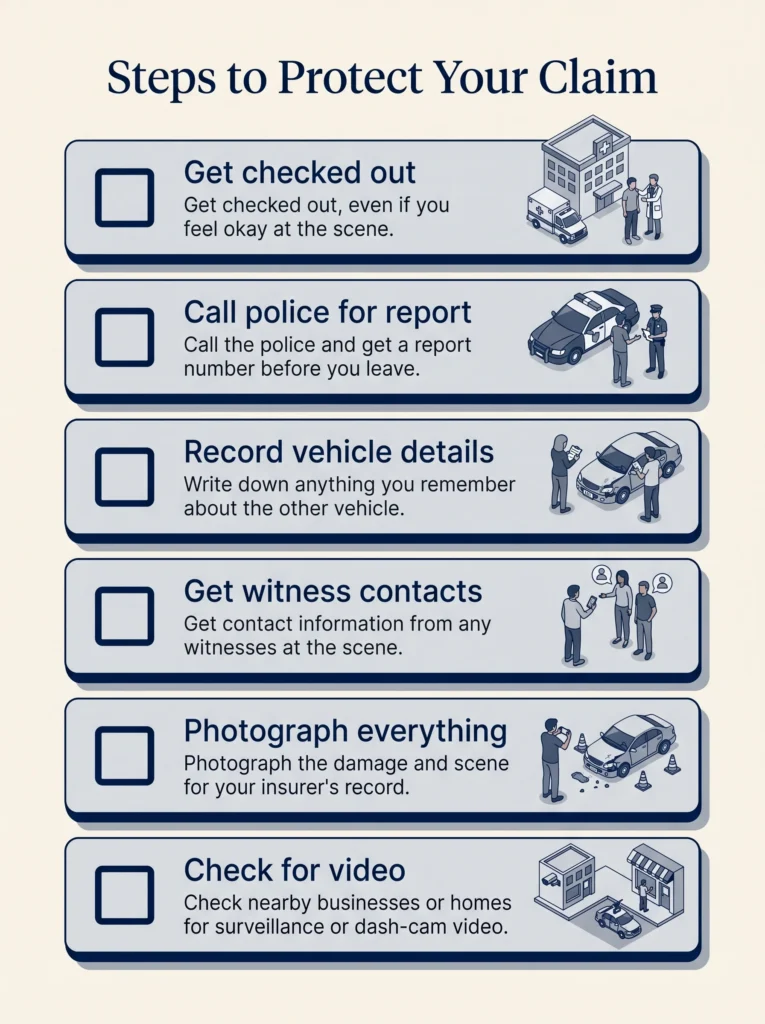
Taking a few steps in the hours after the crash go a long way:
- Get checked out, even if you feel okay at the scene.
- Call the police and get a report number before you leave.
- Write down anything you remember about the other vehicle, and get contact information from any witnesses.
- Photograph the damage and scene, and check nearby businesses or homes for surveillance or dash-cam video.
Texas Deadlines That Can Bar Your Claim
You have two years from the day of the crash to sue for a personal injury in Texas, under Texas Civil Practice and Remedies Code § 16.003.
That date isn’t the only one that matters. Most Texas auto policies also require you to notify your own insurer of a UM claim within a set window as a condition of coverage, and that window is often shorter than two years. Late notice is one of the most common, and most avoidable, reasons an insurer disputes a hit-and-run claim.
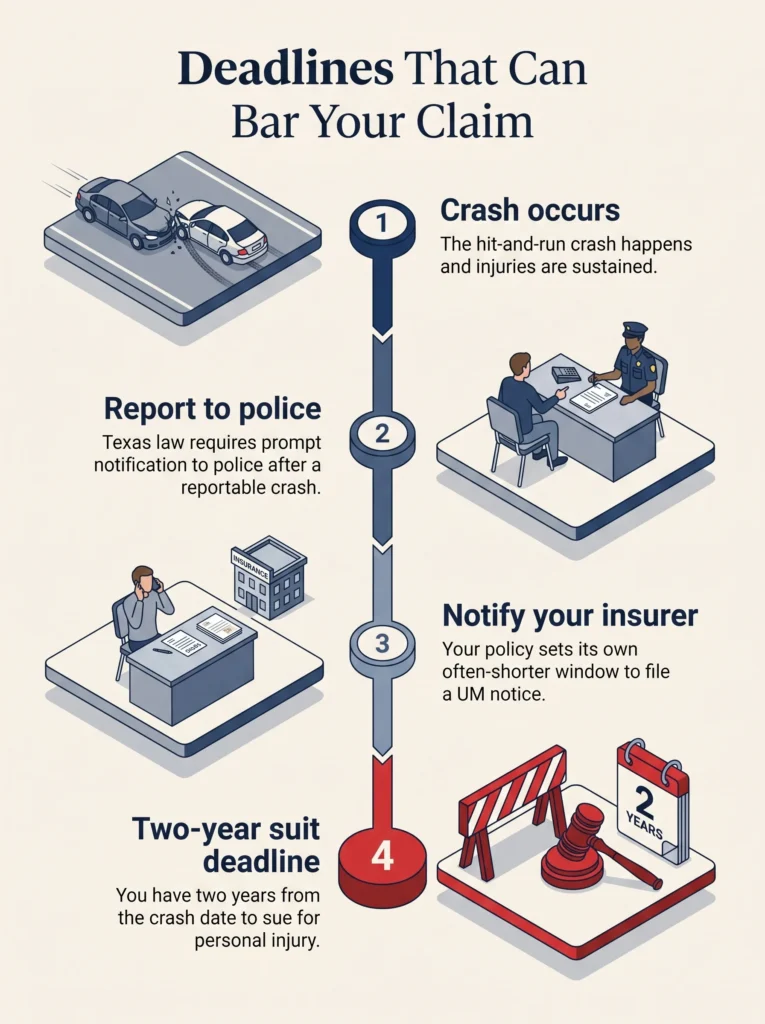
Getting an attorney involved early is the safer move here. The two-year suit deadline and your policy’s own notice requirement can interact in ways that are easy to miss on your own, so protecting every deadline that applies to your claim is worth more than fixating on the one you already knew about.
Get Matched with the Right Attorney
Fighting your own insurance company over a hit-and-run claim, with no other driver to point to, is a strange position to be in. That’s exactly the kind of claim an attorney who works UM and hit-and-run cases handles regularly. We’ll match you with an attorney who can build your case around the physical-contact rule, the police report, and the coverage available on your policy.
It costs you nothing to get matched, and the attorney you’re connected with works on a no-win, no-fee basis. Take our short survey and we’ll match you with the right attorney. If you have questions first, reach out to us directly. We’ll help you figure out the next step.