
Your shoulder still aches weeks after the wreck, and you want to know what that is actually worth. The honest answer starts with one question: did the shoulder need surgery? Everything else about your claim’s value follows from that.
Why Surgery Is the Biggest Value Factor
Whether your shoulder needed surgery, such as a rotator cuff repair or a labral repair, is the single biggest thing separating a lower-value claim from a higher-value one. Surgery changes three things insurers and juries actually weigh: the documented cost of your care, how long recovery takes, and the odds you are left with a lasting deficit in strength or motion.
There is no honest, sourced number for what a Texas shoulder claim is worth on average. What does have real numbers behind it is treatment cost, and that is where the surgery question shows up first.
Treatment Costs With Surgery vs. Without
A shoulder that heals without surgery and one that needs a rotator cuff or labral repair leave very different paper trails, and the gap shows up fast.
The Non-Surgical Cost Range
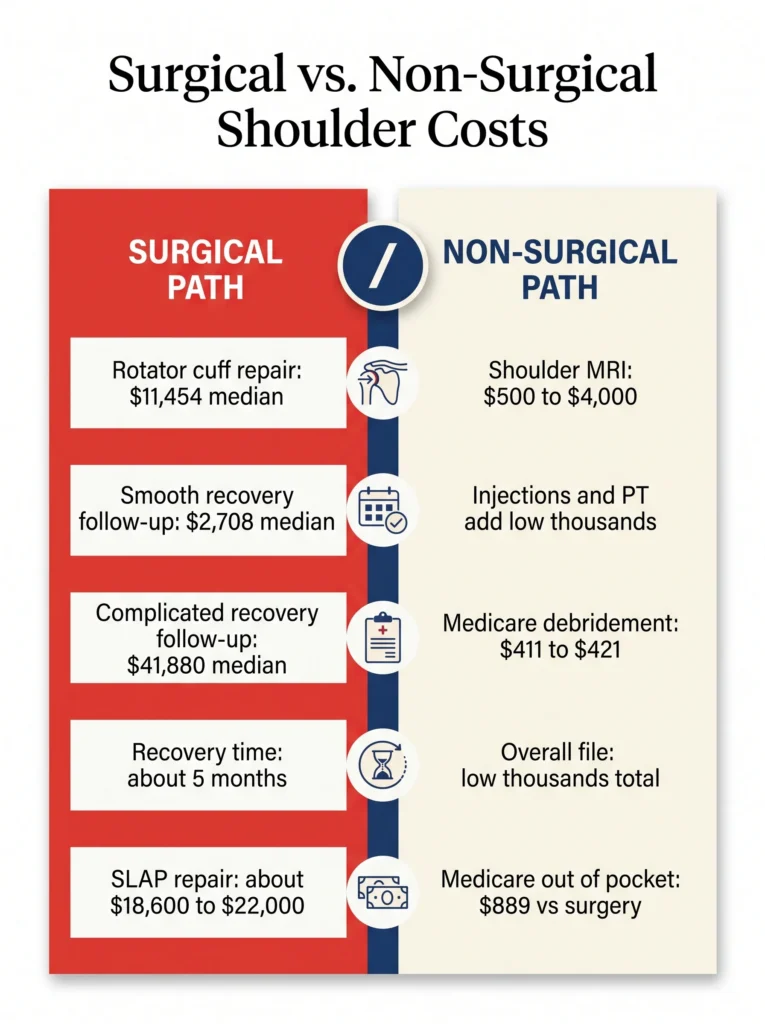
A shoulder MRI’s facility cost alone commonly runs $500 to $4,000 in cash-pay pricing, averaging around $1,874, across the hospitals and imaging centers a University of Iowa research team called around the state, published in Clinical Orthopaedics and Related Research.
Add injections and months of physical therapy on top of that imaging, and a documented non-surgical file commonly lands in the low thousands overall.
The Surgical Cost Range
A rotator cuff repair carries a median surgery cost of $11,454, with recovery typically running about five months, according to a 2025 national claims-database study in the Journal of Medical Economics. When recovery goes smoothly, the follow-up care adds a median $2,708 on top.
When it does not go smoothly, the cost jumps. A revision surgery or a hospitalization for infection or a blood clot pushes that follow-up cost to a median $41,880, with recovery stretching past 15 months.
A labral, or SLAP, tear repair costs even more. Research using ambulatory-surgery data from six states found average costs from about $18,600 for an open biceps tenodesis to roughly $22,000 for an arthroscopic SLAP repair, depending on which technique is used, published in Arthroscopy, Sports Medicine, and Rehabilitation.
Medicare’s own 2024 numbers show the same pattern at a smaller scale: a surgical rotator cuff repair at an outpatient surgical center averaged $889 out of pocket, next to $411 to $421 for non-surgical arthroscopic debridement, according to Healthline’s review of CMS Medicare data.
None of these figures are a settlement number. They are what the care itself costs, and that documented cost is the foundation the rest of your claim gets built on.
What Else Drives Your Claim’s Value?
Once you know whether surgery was involved, a few other facts do the real work of setting where your claim lands: how permanent the damage is, what future care and lost earning power look like, and how fault gets divided.
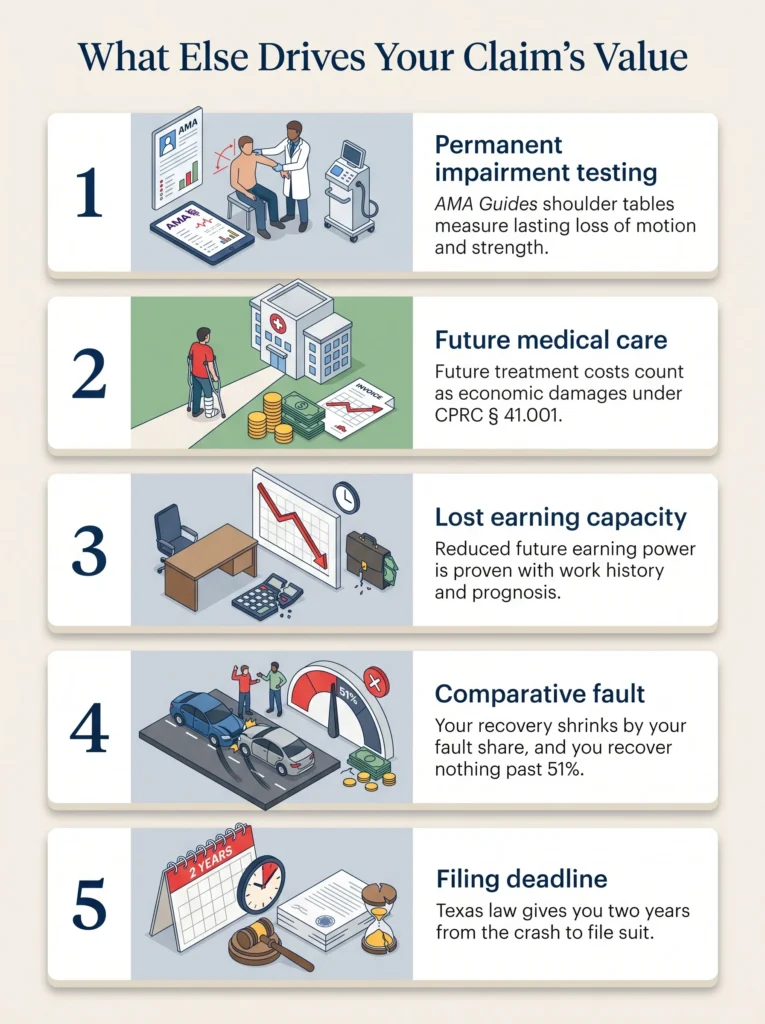
A shoulder’s permanent impairment gets measured through objective testing. Orthopedic evaluators score lasting loss using the AMA Guides’ shoulder-specific tables, which weigh range of motion and strength rather than how much pain you report. An orthopedist’s opinion tying your ongoing limits to that scale carries far more weight than a pain journal.
Two categories of Texas law shape what you can recover beyond that:
- Under the Texas Civil Practice and Remedies Code (CPRC) § 41.001, future medical care and lost earning capacity are economic damages, the same category as your medical bills and lost paychecks, not pain and suffering. Lost earning capacity is bigger than lost wages: it is your reduced ability to earn going forward, proven with your work history, your medical prognosis, and your actual functional limits, not with a bill you have already paid.
- Under Texas Civil Practice and Remedies Code (CPRC) § 33.001, Texas follows a modified comparative-fault rule. You can still recover if you are 50% responsible or less, though your
award shrinks by your share. Cross 51%, and you recover nothing.
You also have two years from the crash to file suit under Texas Civil Practice and Remedies Code (CPRC) § 16.003. Every one of these factors gets weighed together once you file a car accident claim, which is why the record you build now matters as much as the injury itself.
Answering the Pre-Existing Wear Defense
Insurers reach for pre-existing shoulder wear almost by reflex, and the defense is weaker than it sounds.
Rotator cuff tears show up in roughly 22% of shoulders in the general population, and that share climbs with age, from about 11% in your 50s to nearly 37% in your 80s. Most of those tears never hurt: asymptomatic tears turn out to be roughly twice as common as ones that actually cause pain, according to a mass-screening study published in the Journal of Shoulder and Elbow Surgery.
Texas juries are instructed to award damages for the aggravation of a real, pre-existing condition, the same as they would for any other prior injury a wreck makes worse. You do not need a flawless shoulder going into the crash to recover for what the crash did to it.
What actually separates a crash-caused tear from ordinary wear is the full record: your history before the wreck, the mechanism of the crash itself, what the initial exam and imaging showed, and how your function changed afterward. That combination is what tells the real story.
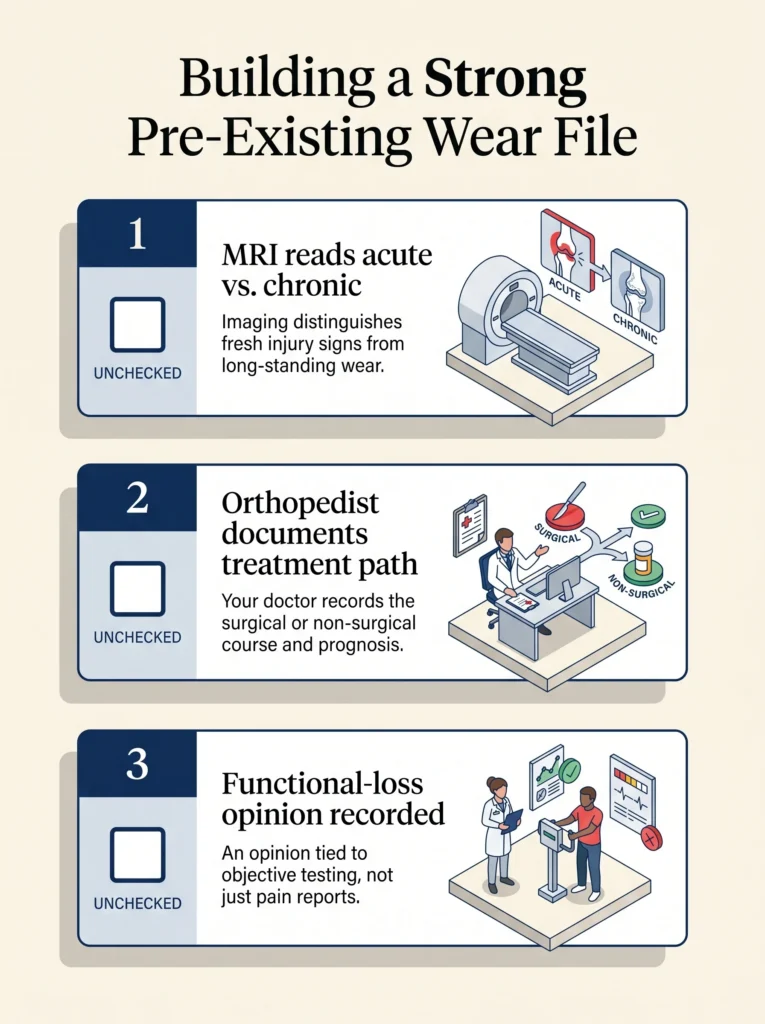
A strong file usually includes:
- The MRI reads for acute signs versus chronic wear, not just a tear-or-no-tear result.
- Your treating orthopedist documenting the surgical or non-surgical path and the prognosis.
- A functional-loss opinion tied to that record instead of resting on how much pain you describe.
Find the Right Attorney for Your Claim
A shoulder injury with this many moving pieces, imaging, a surgery decision, a permanence opinion, a fault fight, is exactly the kind of claim where the right attorney earns their keep.
Texas Crash Network can match you with an attorney who fits a claim like yours, such as a straightforward physical-therapy recovery or a rotator cuff repair with lasting limits. Take our short survey and we’ll match you with an attorney, and it costs nothing to find out: no attorney fees unless the attorney you’re matched with wins.
If you would rather ask a question first, reach out directly before committing to anything.