You got rear-ended, and the other driver’s insurance already put a number on the table. Something about it feels low, especially once you add up your medical bills and the work you missed. Your settlement was never a fixed number to begin with. It comes down to a handful of provable factors, and knowing them is how you push back on a lowball offer.
What Actually Decides Your Settlement Value?
There’s no verified average settlement for a rear-end crash in Texas. What actually decides your Texas car accident claim‘s value comes down to a handful of things:
- How clearly fault is established
- Your diagnosis and how it’s treated
- How much of your loss already happened versus what’s still ahead of you
- Whether you share any fault for the crash
- How much insurance is actually there to pay you
Texas requires drivers to carry at least 30/60/25 in liability coverage, according to the Texas Department of Insurance: $30,000 per injured person, up to $60,000 total per crash, and $25,000 for property damage. That’s the ceiling on what the at-fault driver’s own policy can pay you, unless you have coverage of your own, like underinsured motorist protection, to fill the gap.
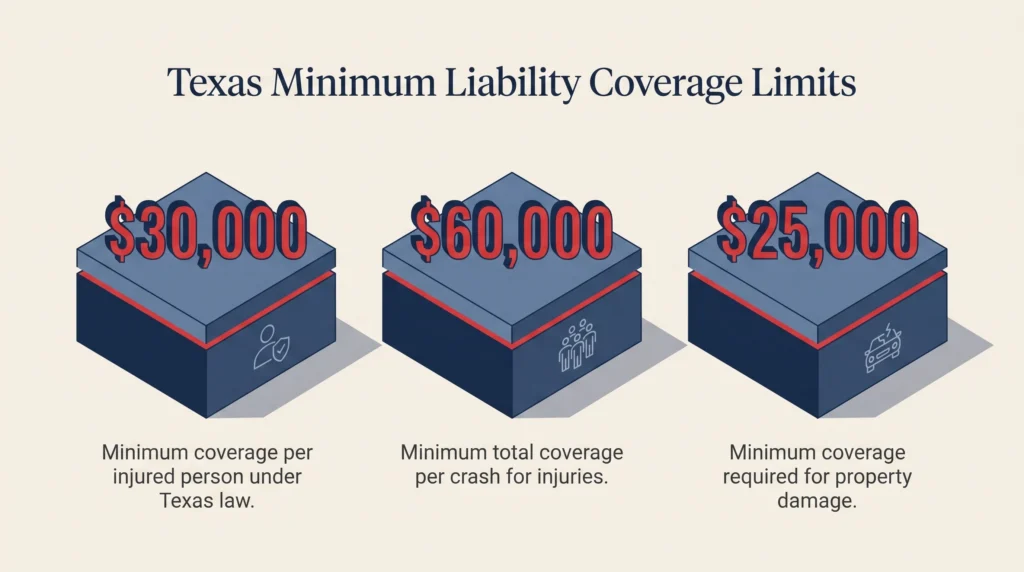
Even a crash with airtight fault and serious injuries runs into that ceiling if the other driver was only carrying the state minimum.
Why Fault Is Usually Clear, but Not Automatic
Rear-end crashes tend to have clearer fault than other Texas crash types, because state law puts a specific duty on the driver behind you. Texas Transportation Code § 545.062 requires a driver following another vehicle to keep an assured clear distance, enough room to stop safely without hitting you.
A driver who breaks that duty and hits you from behind has already violated a specific rule, and that violation can support a negligence claim.
That said, Texas courts haven’t gone as far as saying a rear-end crash proves negligence automatically. In Stone v. Sulak, 994 S.W.2d 348, 351 (Tex. App.-Austin 1999, no pet.), the Austin Court of Appeals held that getting rear-ended is “some evidence” the trailing driver was negligent, not proof as a matter of law.
The other driver’s insurer can still argue you share some blame: that you stopped suddenly for no reason, cut them off, or had brake lights that weren’t working.
That argument matters because Texas follows a 51% bar rule under the Texas Civil Practice and Remedies Code (CPRC) § 33.001. If you’re found more than half responsible for the crash, you recover nothing. At 50% or less, your recovery gets reduced by your own share instead. A rear-end crash with an otherwise clear story can still shrink in value if the insurer manages to pin even a slice of fault on you.
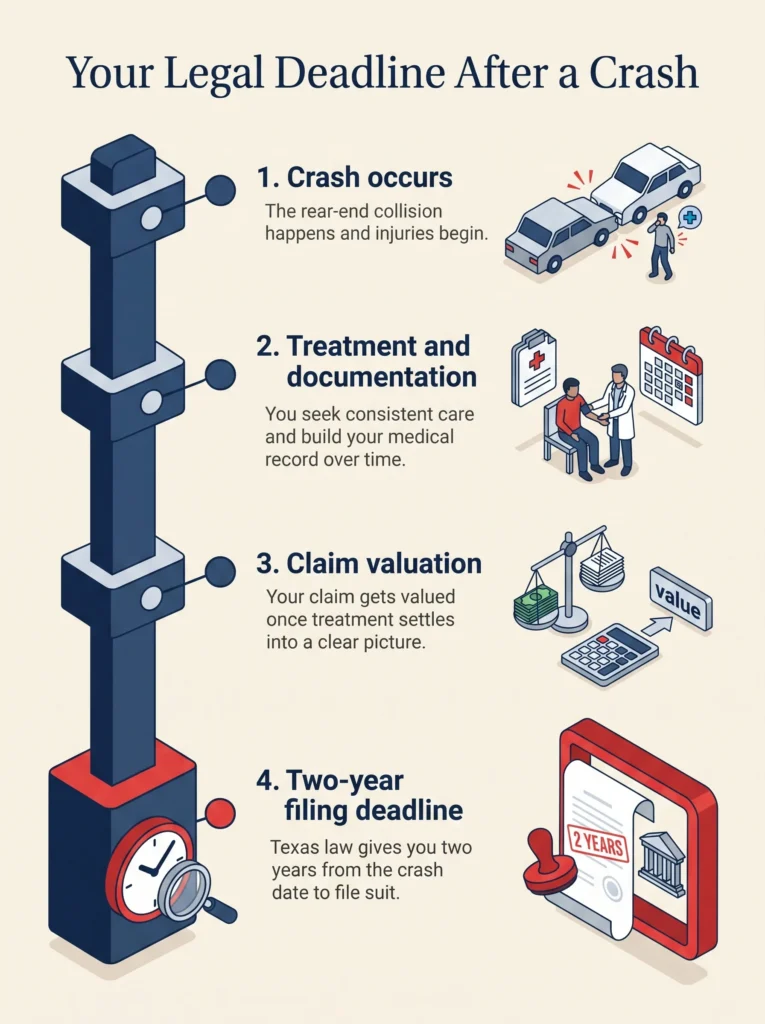
You also don’t have unlimited time to act. Texas Civil Practice and Remedies Code (CPRC) § 16.003 gives you two years from the crash date to file a personal injury lawsuit in Texas. Waiting until the fault question feels fully settled can cost you the right to sue at all.
How Your Injury and Treatment Set the Value
Your diagnosis and how consistently you treat it do more to set your claim’s value than anything else in your file. Diagnosis, severity, and prognosis are three different questions, and mixing them up costs you.
Diagnosis is what’s actually wrong. Severity is how bad it is. Prognosis is whether it’s expected to resolve or stick around. A whiplash diagnosis that clears up in six weeks is worth something different than one that leaves you with permanent limits, even though both started the same way.
Consistent treatment is what proves the injury happened and that the crash caused it. Gaps in care, or stopping treatment early because the pain seems to fade, give the insurer room to argue your injury wasn’t serious or wasn’t really from the crash. Following through with the care your doctor recommends, and keeping the records that go with it, is what builds the proof behind your number.
Your claim also covers more than bills you’ve already paid. Past loss is what already happened: medical bills you’ve incurred and wages you’ve already lost. Future loss counts too: ongoing care you’re likely to need and any lasting hit to your ability to earn, as long as reasonable evidence, usually your treating doctor’s own opinion, supports it.
None of this works if the causal link is weak. Your medical records need to actually connect your diagnosis to the crash, not just note that a crash happened around the same time.
Why the “Low-Impact” Argument Doesn’t Decide Your Claim
If the adjuster is pointing at your bumper and telling you your injury can’t be that bad, that argument isn’t backed by medical research. A 2017 systematic review in the Journal of Orthopaedics and Traumatology, Sarrami and colleagues, looked at what actually predicts how a whiplash injury turns out.
Crash-related factors, including how fast the vehicles were going, weren’t associated with the outcome at all. What did predict a worse outcome was the medical picture: how much pain and disability you had after the crash, your whiplash grade, and how early you got care.
In other words, your medical record is what actually decides your case. An insurer leaning on “the damage was minor, so the injury must be minor too” is running a claims tactic dressed up as science.
Texas law also puts a duty on the insurer here. The Texas Insurance Code § 541.060 requires an insurer to try, in good faith, to reach a prompt, fair settlement once its liability is reasonably clear. A lowball offer based on your bumper, after your diagnosis and treatment already establishes your injury, runs against that duty.
Get Matched with an Experienced Attorney
You shouldn’t have to fight the insurance company alone while you’re also trying to get better. Texas Crash Network can match you with an attorney who takes on claims like yours, at no cost to find out where you stand. If you hire the attorney we match you with, you pay no attorney fees unless they win your case.
See if you qualify in a few minutes, or if you have questions first, reach out to our team.