Your head snapped forward, the airbag went off, and days later the headache and fog still have not lifted. You are trying to figure out what that is actually worth, but every number you find online looks like a guess. While there is no single published average for a concussion or brain injury settlement, real value comes down to three concrete factors: how severe the injury turns out to be, how thoroughly it gets documented, and how much insurance is actually there to pay it.
Why Concussion Severity Drives Claim Value
What actually drives value is where your injury lands on one severity scale, not whether it is called a concussion or brain injury. Doctors classify traumatic brain injury (TBI) using the Glasgow Coma Scale (GCS), running from 3 for most severe to 15 for normal, along with the duration of unconsciousness and memory loss. A GCS of 13 to 15 with a brief loss of consciousness is what gets called a concussion, or mild TBI; the CDC describes a GCS of 9 to 12, with unconsciousness lasting 15 minutes to 6 hours, as moderate; and anything from 3 to 8 as severe.
That initial score is only half the picture, while about 90% of concussion symptoms clear up within 10 to 14 days, roughly 15% to 30% of concussion patients suffer persistent symptoms, and about 15% still report problems a year out. According to NCBI’s clinical reference on postconcussive syndrome that persistence, more than the initial diagnosis, is usually what separates a modest car accident claim from a substantial one. A clean CT or MRI at the emergency room does not rule out a real injury, because these scans are built to catch bleeding and major structural damage, rather than every type of brain injury.
What Treating the Injury Actually Costs
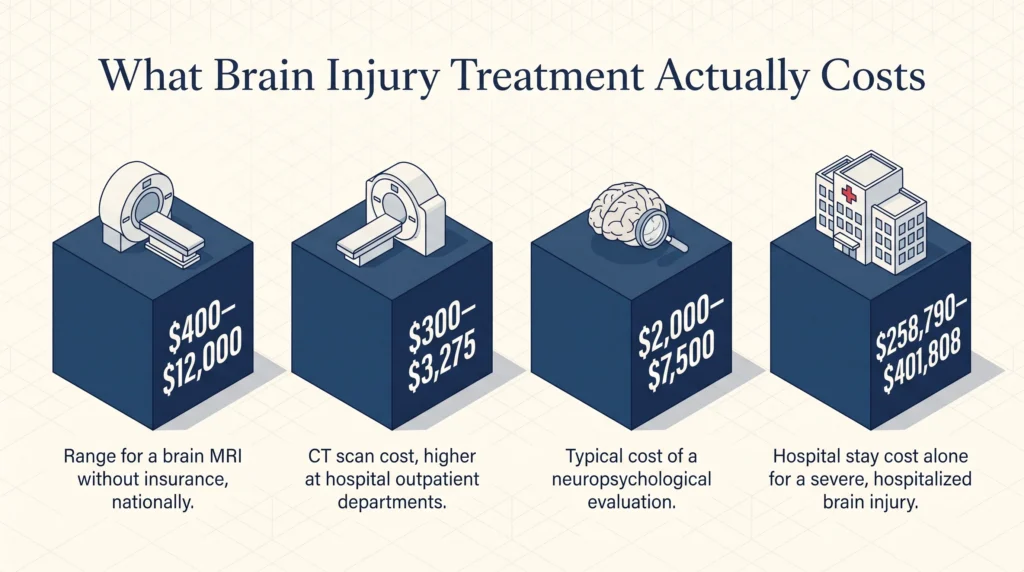
Here is a real, sourced range for what treating a concussion or brain injury costs. This is a treatment-cost range tied to severity, not a settlement number.
- A brain MRI without insurance runs roughly $400 to $12,000 nationally, with a national average close to $1,325, according to GoodRx. Brain scans tend toward the higher end because they need a specialist’s interpretation.
- A CT scan, often the first imaging ordered at the emergency room, costs roughly $300 to $1,000 at an independent imaging center and considerably more (commonly $1,200 to $3,275) at a hospital outpatient department, per the same GoodRx cost reporting cited above.
- A neuropsychological evaluation, the testing that documents cognitive deficits over weeks and months instead of in one emergency room visit, is commonly reported by neuropsychology providers in the $2,000 to $7,500 range, with cost driven mainly by how complex the referral question is and whether the evaluation is built for litigation.
- For a severe, hospitalized brain injury, a peer-reviewed systematic review of in-hospital costs found U.S. hospital studies reporting $258,790 to $401,808 per patient for the hospital stay alone, driven mainly by how long a patient spends in the ICU.
None of these figures is a settlement value. They are what it costs to diagnose and treat the injury, one input a claim has to account for, not a prediction of what a case pays.
Lost Income & Diminished Earning Capacity
Your claim can include two different kinds of income loss, proven in two different ways.
- Past lost wages cover the paychecks you already missed, documented through pay stubs and a letter from your employer.
- Diminished earning capacity covers what the injury costs you going forward, when a documented cognitive or physical limit means you cannot do the same job, the same hours, or advance the way you otherwise would have.
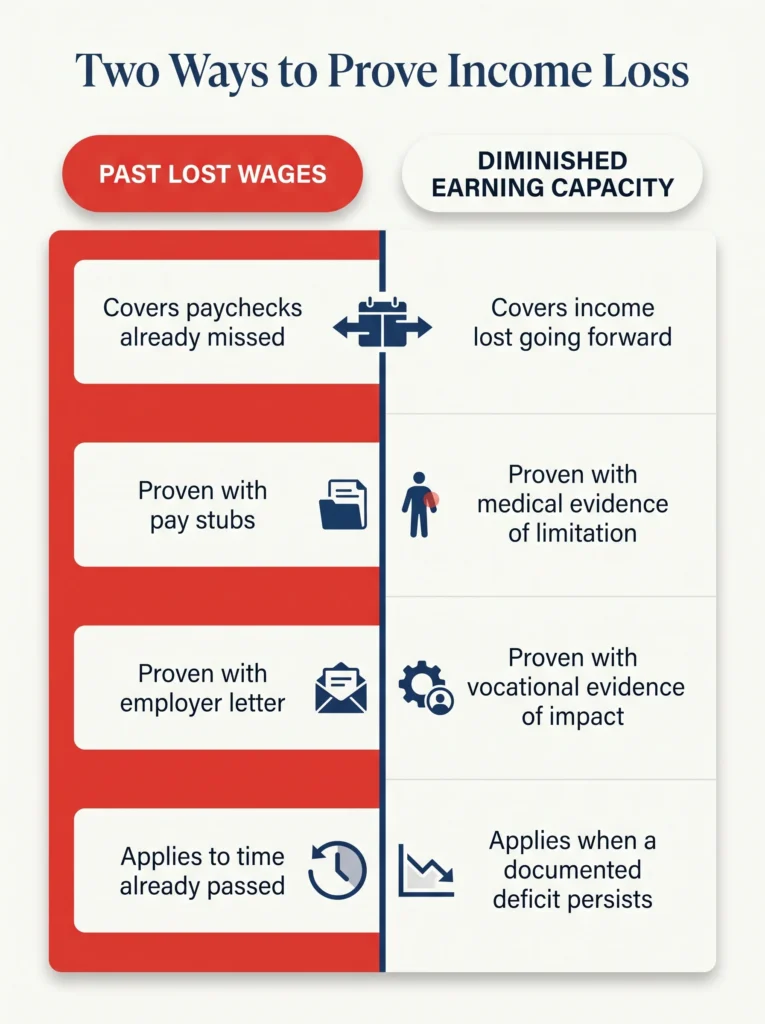
Both are economic damages, neither is a secondary category, and neither requires a dollar figure that is already paid or known exactly today. Future earning-capacity loss gets proven with medical evidence establishing the limitation and vocational evidence translating that limitation into lost future income, not simply asserted because a crash happened. If your concussion resolved in two weeks with no lasting restriction, this category likely does not apply; however, if a neuropsychologist has documented an ongoing deficit that affects the work you can do, it does.
What Can Reduce Your Recovery
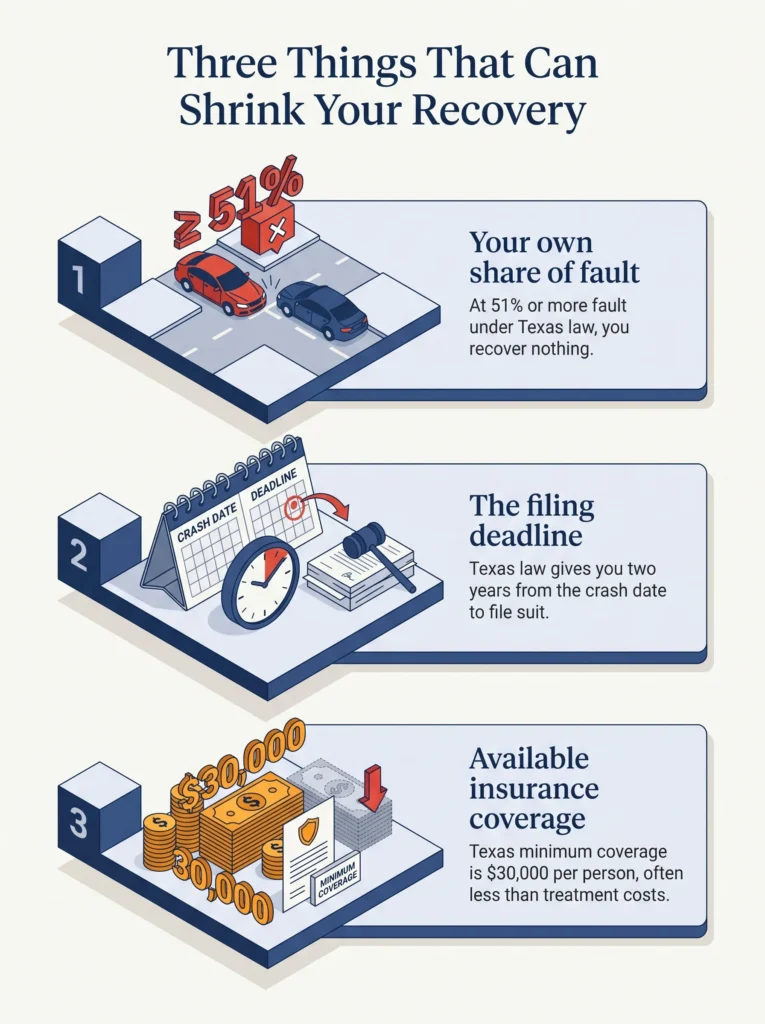
Three things can shrink what you actually collect, no matter how well-documented your injury is.
- Your own share of fault. Under Texas Civil Practice and Remedies Code (CPRC) § 33.001, if you are found 51% or more responsible for the crash, you recover nothing. At 50% or below, your recovery is reduced by your percentage of fault. A well-documented brain injury claim can still be worth zero if fault tips past that line.
- The filing deadline. In most cases, Texas CPRC § 16.003 gives you two years from the date of the crash to file suit. Miss it, and you generally lose the right to recover at all, regardless of how strong the claim was.
- How much insurance is actually there. Texas Transportation Code § 601.072 requires drivers to carry at least $30,000 per person and $60,000 per accident in bodily injury coverage, a minimum that has been unchanged since 2011 and that often falls well short of documented treatment costs alone. Because of these limits, your own underinsured motorist (UIM) coverage often ends up mattering as much as the at-fault driver’s policy.
Meeting the deadline and being found free of fault does not set a dollar amount. They simply decide whether you can collect anything at all. Severity, permanence, and documentation decide how much.
Find the Right Attorney for Your Claim
A concussion or brain injury claim usually turns on evidence most people are not equipped to build alone: authorizing the right imaging, a neuropsychological evaluation, and documenting long-term deficits. For a severe injury, it also means bringing in a life-care planner to project future costs and needs. That is exactly the kind of work an experienced attorney handles.
Texas Crash Network takes the burden off your plate by matching you with the right attorney for your specific claim. Take our short survey to get guidance to see where you stand; matching is completely free, and you pay nothing unless your attorney wins. Reach out with questions first if you are not ready to commit to anything yet.
We provide support in both English and Spanish.