You got hurt in an Uber or Lyft, and now you’re parsing insurance rules instead of resting. Here’s the honest starting point: no one can hand you a number without knowing which insurance policy was actually covering that ride the moment the crash happened. Texas sets three different coverage ceilings for a rideshare trip, and your crash almost certainly falls under just one of them.
Which Insurance Period Sets Your Claim’s Ceiling?
The real ceiling on your claim is set by which of three legally required insurance periods was active when the crash happened, not by how badly you were hurt. Texas law splits every rideshare trip into three distinct windows, and each one carries its own coverage amount.
- App off: The driver wasn’t logged into the Uber or Lyft app at all. No rideshare coverage applies. Only that driver’s personal auto policy is in play, at whatever limits they personally carry.
- App on, waiting for a match: The driver was logged in and available but hadn’t accepted a ride yet. Under Texas Insurance Code § 1954.052, the rideshare company must provide at least $50,000 per person and $100,000 per incident in injury coverage, plus $25,000 for property damage, during this waiting window.
- Ride accepted through drop-off: From the moment the driver accepts your ride until you’re out of the car, Texas Insurance Code § 1954.053 requires at least $1 million in primary liability coverage. This is the figure Uber discloses to its own drivers and riders, and Lyft’s coverage is built to the same statutory floor.
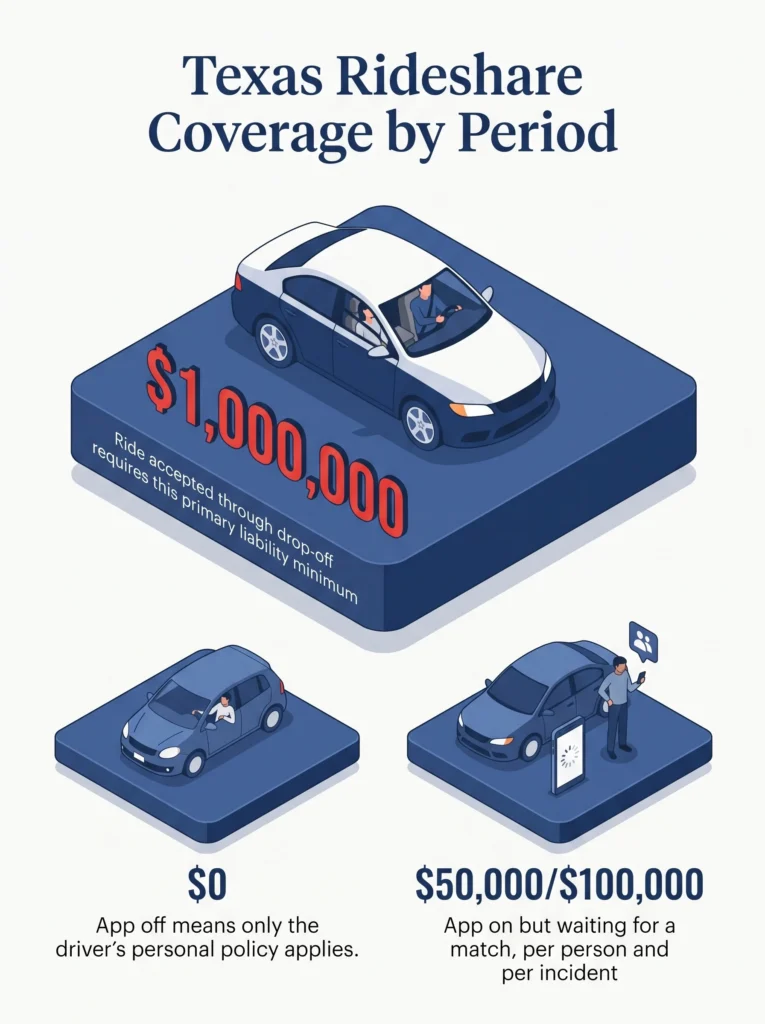
A good attorney’s first move in a rideshare case is pinning down exactly which window was open at the moment of impact, usually by pulling the trip and app data straight from the company. This single fact decides whether your case sits near a $1 million ceiling, a $100,000 ceiling, or whatever the driver personally carries.
How Your Role Changes Your Claim
Whether you were riding in the Uber or Lyft, driving another car, or crossing the street changes which policy you look to first, even though the same three ceilings above still set the outside limit.
- You were the rideshare passenger: If your own driver caused the crash, you look to the on-trip $1 million policy. If a different driver caused it, you can also bring a claim against that driver’s own liability policy, the same way you would in any other car accident claim.
- You were driving or riding in another vehicle: Your recovery depends on which car caused the crash and which of the three above periods the rideshare driver was in at that moment. A rideshare passenger is rarely found at fault for the wreck itself, but another driver’s own conduct still gets scrutinized like any other crash.
- You were a pedestrian: The same period-based coverage rules apply to you. Your claim can also raise fault questions a seated passenger’s claim usually doesn’t, since a pedestrian’s own actions before the crash can come into play.
Every claimant type can also look at uninsured or underinsured motorist (UM/UIM) coverage when the at-fault driver’s own policy can’t cover the loss. Texas Insurance Code § 1954.053 requires the rideshare company to carry this coverage itself during an active trip. Texas Insurance Code § 1952.101 requires every Texas auto insurer to offer the same protection on your own policy, unless you rejected it in writing. Whether those policies add together or one simply replaces the other depends on each policy’s own language, which is exactly the kind of detail an attorney sorts out rather than guesses.
What Drives Your Claim’s Value
Once you know your ceiling, the actual size of your claim depends on ordinary, provable facts rather than a formula. This makes how well your treatment is documented immensely important. Medical records that connect your injury directly to the crash, and show consistent follow-up, carry more weight than a gap in care that leaves room for doubt.
Past medical bills and lost income you’ve already documented are one part of the picture, but they aren’t the whole picture. Future medical care and a lasting reduction in your ability to earn are separate, real categories of economic loss, not extras you only collect if the case goes perfectly. A permanent injury that limits what work you can do later is worth accounting for now, not written off because it hasn’t happened yet.
The strength of the evidence tying the crash to the at-fault driver matters just as much. App data, the police report, and any witnesses all shape how contested liability will be, which in turn shapes how quickly and how fully a claim resolves. The insurance ceiling from the first section is the outside limit of what’s available, not a target every claim reaches regardless of the facts.
Rules That Cap What You Recover
Two Texas rules apply on top of everything above, no matter which insurance period covered your crash.
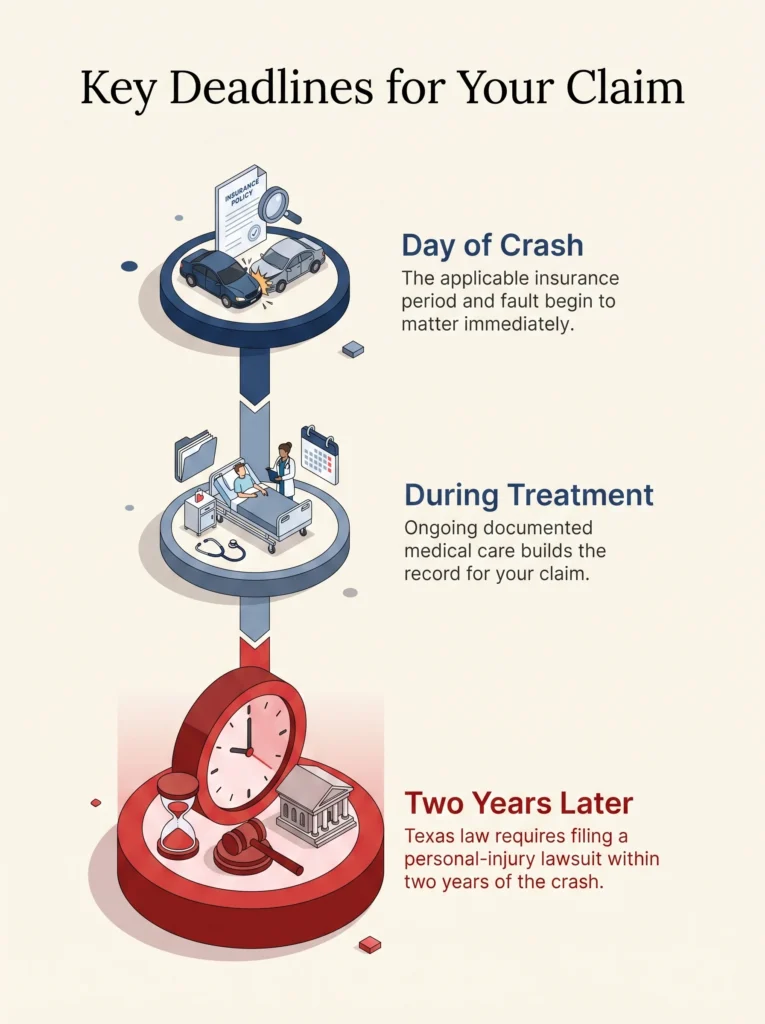
Texas gives you two years from the date of the crash to file a personal-injury lawsuit under Texas Civil Practice and Remedies Code § 16.003. If you miss this window then your claim is generally gone for good, regardless of how strong the facts were or how high the available coverage was.
Texas also follows a 51%-bar fault rule under Texas Civil Practice and Remedies Code § 33.001. If your own share of fault comes in at 51% or higher, you recover nothing. At 50% or below, your award is reduced by your percentage of fault. A rideshare passenger is rarely assigned any fault for the crash itself, but this rule can decide a pedestrian’s or other driver’s claim.
Find the Right Attorney for Your Rideshare Claim
Figuring out which insurance period applied, which policy to pursue, and how Texas’s deadline and fault rules affect your specific crash is exactly the kind of work most people don’t know how to begin. It’s not something you should have to untangle alone while you’re still recovering.
We’ll match you with an attorney who can handle a claim like yours, finding someone who knows how to pull the trip data and pin down the right policy instead of guessing. Matching is free, and you pay no fees unless your attorney wins. Take our short survey and we’ll match you with the right attorney for your situation. Reach out with questions first if you’re not ready yet.