The other driver had no insurance, and now you’re stuck wondering what your claim is even worth. Whatever number you’ve seen floating around online isn’t really the answer. Your real number comes from your own policy and how hard you’re willing to fight to use it.
What Your Claim Is Really Worth
There’s no honest “average uninsured motorist settlement” anyone can hand you. No government agency or insurance research group tracks a real figure for what Texas uninsured/underinsured motorist (UM/UIM) claims actually pay, and a number a law firm’s own website quotes as its average isn’t really sourced at all.
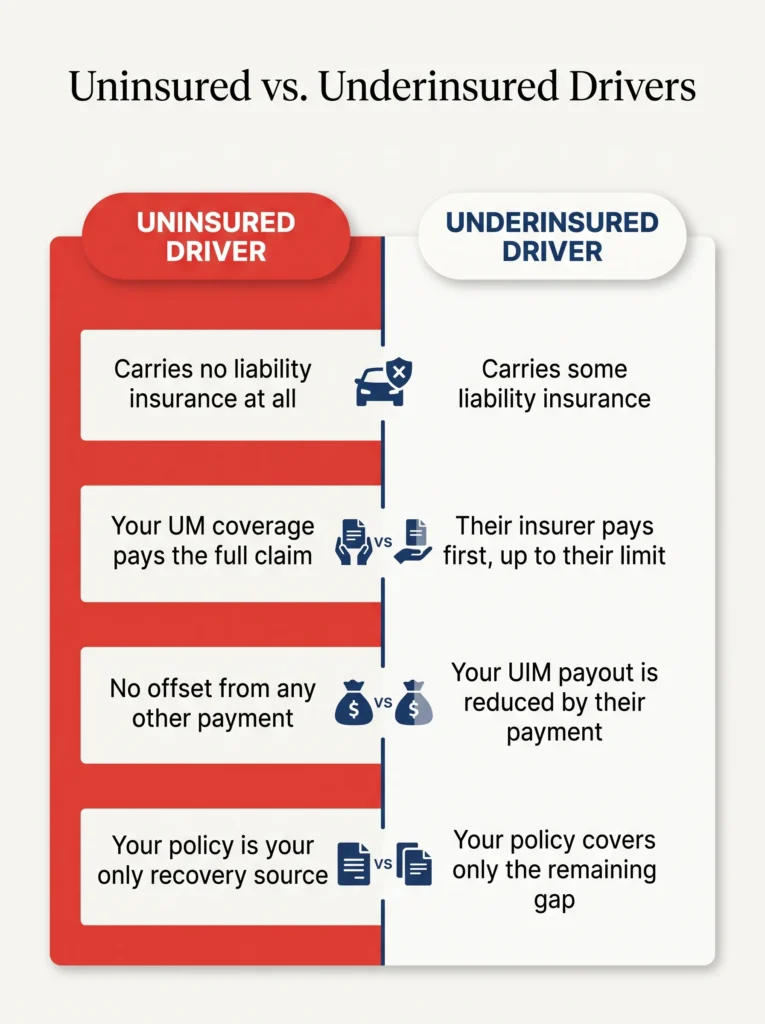
“Uninsured” and “underinsured” cover two different problems: the other driver either has no liability insurance, or has some, just not enough to cover what you’re owed. Either way, your own UM/UIM coverage is what steps in.
What actually decides your number are two figures you can find yourself: the UM/UIM limit on your own policy, and whatever the at-fault driver’s own insurer already paid or could pay toward your claim. Your compensation lands somewhere between those two, driven by your documented medical treatment, lost income, and pain and suffering, not by a number pulled from a national chart.
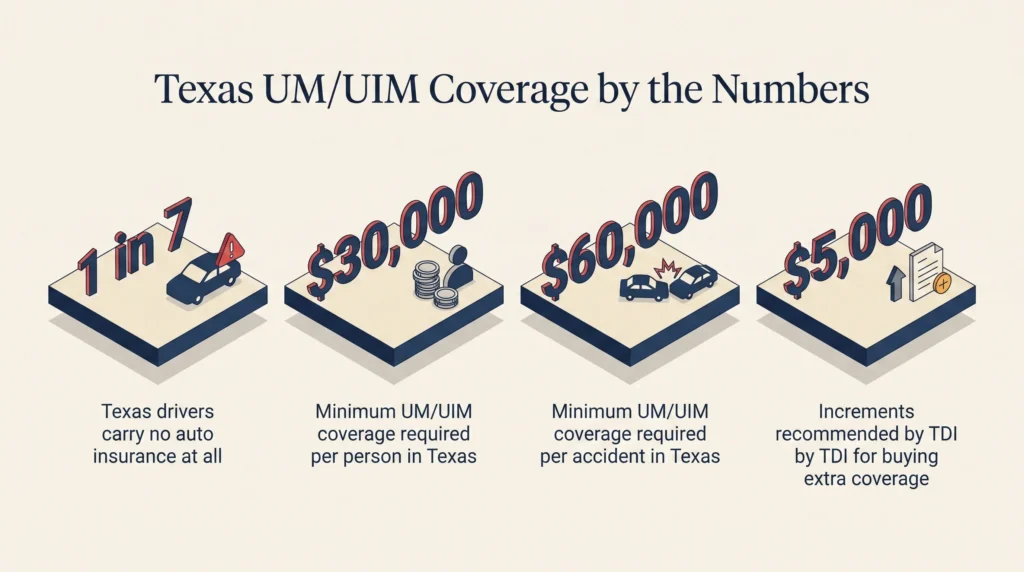
This situation comes up constantly in Texas car accident claims. About 1 in 7 Texas drivers carries no auto insurance at all, according to the Insurance Research Council’s 2022 estimate, republished by the Insurance Information Institute. If you’re dealing with this, you’re dealing with something a lot of other Texans deal with too.
Your Own Coverage Sets the Ceiling
Texas won’t let an insurer sell you a car insurance policy without also offering UM/UIM coverage, either built into the policy or added alongside it. You can turn it down, but only in writing, and once you do, your insurer doesn’t have to offer it again at renewal unless you ask for it per Texas Insurance Code § 1952.101.
Whatever limit you picked when you bought the policy is the hard ceiling on what you can collect later. Your insurer can offer you UM/UIM up to your own bodily-injury liability limit, but never higher, and Texas won’t let anyone set that limit below the state minimum of $30,000 per person and $60,000 per accident under Texas Insurance Code § 1952.105 and Texas Transportation Code § 601.072.
The Texas Department of Insurance recommends buying more than the minimum, in $5,000 increments, and matching your property-damage UM coverage to what it would actually cost to replace your car. The coverage you buy today is the ceiling you’ll be stuck with if you’re ever hit by someone with too little insurance, or none.
The Other Driver’s Insurer Sets the Floor
Underinsured motorist coverage pays only the gap between what money you’re legally entitled to recover and what the at-fault driver’s own insurer already paid you. Your insurer reduces what it owes you dollar for dollar by whatever you already collected from the other driver’s policy per Texas Insurance Code § 1952.106.
A real Texas case shows how this plays out. In Allstate Ins. Co. v. Irwin, a driver ran up $53,240.66 in medical bills, settled with the at-fault driver’s insurer for that driver’s $30,000 policy limit, then went after the remaining gap under his own $50,000 UIM limit.
The Texas Supreme Court held that a declaratory-judgment lawsuit against his own insurer was a proper way to pin down that gap, and that he could recover attorney’s fees for bringing it.
Those numbers are one sourced example, not a benchmark for your claim. What they show is the mechanic: your ceiling minus what the other driver’s insurer already paid is your real number, and getting your insurer to agree on that number is often its own fight.
Your Own Insurer Will Fight This Claim
Filing this claim with your own insurer can turn into a real fight.
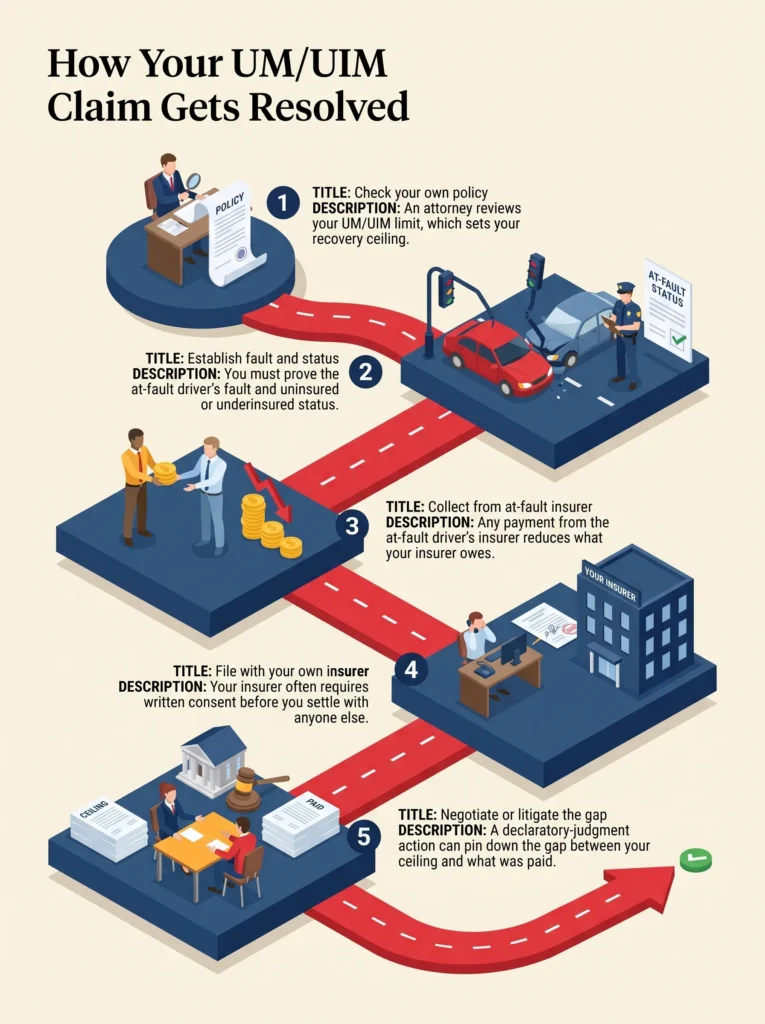
Texas courts have held that your UM/UIM insurer owes you nothing until you actually establish the at-fault driver’s fault and their uninsured or underinsured status, usually through a judgment or a declaratory-judgment proceeding against your own insurer that pins down those two facts (Brainard v. Trinity Universal Ins. Co., 216 S.W.3d 809 (Tex. 2006)).
Once your insurer pays your claim, it steps into your shoes and can go after the at-fault driver for what it paid out. That subrogation right is why most policies require your written consent before you settle directly with the at-fault driver: your insurer wants its shot at recovering that money later.
That consent requirement has a real limit, though. Your insurer can deny your claim over a settlement made without its consent only if it proves that settlement actually hurt it, for example by costing it a real recovery it could have collected from the at-fault driver (Hernandez v. Gulf Group Lloyds). If your insurer can’t show it lost anything, it can’t use your settlement to deny your claim.
Find the Right Attorney for Your Claim
Finding your real number means knowing where to look for it and being ready to fight for it. A good attorney starts by pulling your own policy to check what UM/UIM coverage you actually carry, since that’s often the real source of your recovery when the at-fault driver can’t pay.
From there, the attorney handles the back-and-forth with your own insurer, the consent it wants before you settle with anyone, and the proof needed to show exactly what your claim is worth. Texas Crash Network can match you with an attorney who can handle a claim like yours, at no cost to you.
Matching is free, and you owe no attorney fees unless the attorney wins your case.
Take our short survey and we’ll match you with the right attorney, or if you just have questions first, reach out and we’ll point you in the right direction.