Searching online for “What’s an 18-wheeler accident settlement actually worth in Texas” might leave you with more questions than answers. Finding a number that will give you some idea of what your claim might be worth might seem simple, but it’s rarely straightforward. There’s a good reason for this: no two truck accidents are identical, and even two similar accidents can have dramatically different values and outcomes.
On average, a serious 18-wheeler claim is typically worth significantly more than a typical car accident claim. But how much more typically depends on the individual facts around each case. And, more importantly, how thoroughly the details are documented to provide proof that backs up a claim.
Commercial Truck Insurance Limits in Texas
The potential value of a truck accident claim comes down to a basic difference in insurance requirements. Federal law generally requires the trucking company to carry substantially more liability coverage than a typical passenger vehicle. The larger coverage limit can increase the amount of insurance available to compensate an injured person.
Federal rules establish the baseline. Under 49 CFR § 387.9, most for-hire carriers transporting general freight in trucks that weigh over 10,001 pounds must carry at least $750,000 in combined liability coverage before they’re allowed on the road.
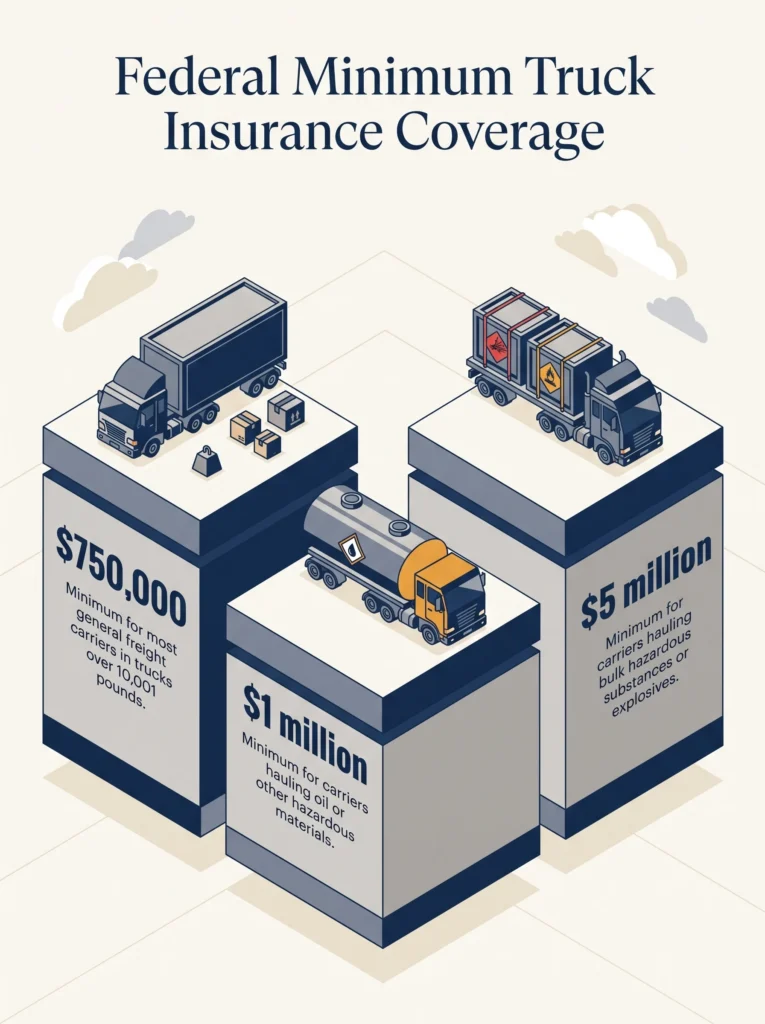
FMCSA’s insurance filing rules set two additional minimums for carriers transporting certain types of hazardous materials and other regulated cargo.
Here’s how it breaks down:
- $750,000 for most general freight carriers in trucks over 10,001 pounds
- $1 million for carriers hauling oil or other hazardous materials in the same weight class
- $5 million for carriers hauling bulk hazardous substances or explosives-class materials
That amount is a legal minimum insurance requirement, not a guarantee of what your claim will pay out. This is important because a serious truck crash may involve substantially more liability coverage than a typical driver’s personal auto policy. The coverage available is only one part of the claim, but it helps explain why a truck claim’s potential value is so different from a fender-bender.
So, where does that leave the “average truck accident settlement” that you searched for? Unfortunately, there is no reliable, independently verified average settlement figure that can tell you what your truck accident claim is worth. Numbers published online often come from a single law firm’s previous cases, but those figures cannot reliably predict the value of your specific claim.
The truth is that a commercial vehicle accident settlement in Texas depends on the specific facts of your case, including:
- The type and severity of your injuries
- Who caused the crash
- How much insurance coverage is available to compensate you
Remember, the size of a commercial policy may increase the potential coverage, but it does not determine what your individual claim is worth.
Who Can You Sue After a Truck Accident?
A car accident usually involves a single at-fault driver, but a truck crash usually involves additional parties, such as the trucking company. Texas law may allow you to pursue claims beyond the individual driver when the evidence supports it.
If the driver was doing their job when the crash happened, the trucking company may be held responsible for the diver’s conduct, which is called vicarious liability by Texas courts.
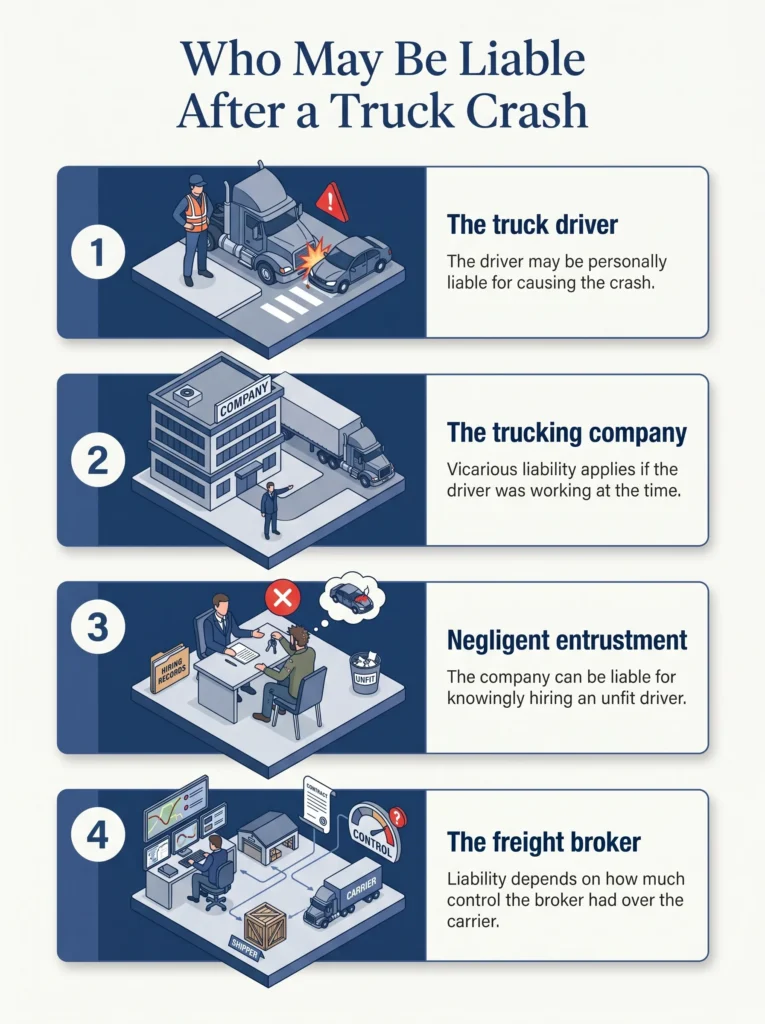
If the trucking company knew or should have known that the driver was unlicensed, incompetent, or reckless, then you may be able to file a separate claim against the company for negligent entrustment. Texas recognizes this along with related claims involving negligent hiring and retention practices.
If a freight broker was involved, they may also be held responsible for the crash, but this depends on the applicable law, the facts of the case, and how much control the broker had over the carrier and driver. In this case, your attorney must evaluate the broker’s specific role before deciding whether it is possible to file a claim against them.
Identifying who may be legally responsible and determining how much insurance coverage may be available is exactly the kind of investigation work that experienced truck accident attorneys can handle early, before evidence disappears and deadlines approach.
Evidence Disappears Fast
It’s important to act fast after a truck crash because the evidence that is used to prove what happened is subject to federal recordkeeping requirements and retention periods. Unfortunately, most of it is maintained by the trucking company.
Most trucks operating in interstate commerce use an electronic logging device that records the driver’s hours behind the wheel, under 49 CFR Part 395. These records are not necessarily permanent. 49 CFR § 395.8 only requires the carrier to keep hours-of-service records for six months after receiving them.

Many trucks also have an event data recorder (often called the “black box”) that captures speed, braking, and other details from the crash. This data can be overwritten before the six-month deadline regardless of whether the truck stays on the road or goes in for repairs. Maintenance and inspection records may also be subjected to limited retention periods.
This is why attorneys who handle truck accident cases send a spoliation letter (a formal demand to preserve evidence) to the trucking company, driver, and freight broker early in the case. Once the letter arrives, the recipient has a legal duty to preserve the evidence. Destroying it after receiving this letter can result in harsh penalties in court.
This is why it’s important to act quickly. If you wait too long to send a spoliation letter, then the evidence that could prove the truck driver’s liability or document the severity of your injuries may disappear.
Texas Rules That Can Limit Your Claim
Two ordinary Texas rules can reduce or dismiss your claim, no matter how strong it looks on paper:
- Texas gives you two years from the date of your injury (or two years from the date of death in a wrongful death claim) to file a lawsuit, under Texas Civil Practice and Remedies Code § 16.003. If you miss that deadline, then you generally lose the right to sue (though limited exceptions exist for an injury that couldn’t reasonably have been discovered right away).
- Texas also reduces or eliminates what you can recover based on your own share of fault for the accident (a rule known as proportionate responsibility). Under Civil Practice and Remedies Code § 33.001, you recover nothing if a jury finds you more than 50% responsible for the crash. If you are found 50% or less at fault, then your recovery is reduced by your percentage of fault.
Neither of these rules is specific to truck crashes, but evidence preservation is especially important in these cases because the trucking company’s own investigators, adjusters, and lawyers will often start trying to say you were at fault within days of the crash, while important records and other evidence may only be kept for a limited time.
Get Legal Help With Your Truck Accident Claim
When you’re dealing with a trucking company that has more insurance, legal resources, and experience handling crashes than the average driver who might clip you in a parking lot, your claim can get complicated fast.
Texas Crash Network can make things easier by matching you with a truck accident attorney who fits your specific case. Matching is free, and you pay no attorney fee unless your attorney wins your case.
Take our short survey, and we’ll match you with the right attorney. Feel free to reach out to us anytime with questions.