
Your back or neck has hurt since the crash, the adjuster has an offer on the table, and you don’t know if it’s fair. There’s no fixed number for a back or neck injury claim. What determines yours starts with a simple question: what kind of treatment did the injury actually require?
What Determines How Much Your Claim Is Worth?
Your claim’s value comes down to a specific set of facts about your case:
- What kind of treatment the injury required: conservative care, injections, or surgery
- What the imaging actually shows: a strain, a herniated disc, or a fracture
- How consistently the injury was treated and documented
- How clearly a doctor can tie your symptoms to the crash rather than to preexisting wear and tear
- Whether the impairment is temporary or permanent
- Your own share of fault, and how much insurance coverage actually exists to pay a claim
How much treatment was needed is the biggest factor. A strain that clears up with a few weeks of physical therapy is different from an injury that eventually needs a fusion. No legitimate source publishes a single reliable average settlement covering both. What actually happened to you and how well it’s documented set your number, not a formula.
Your back or neck injury is usually part of a broader car accident claim, under which fault and coverage rules also apply.
How the Treatment Needed Changes Your Claim’s Value
Back and neck injuries aren’t one diagnosis. They range from a soft-tissue strain with no visible damage on imaging, to a herniated or bulging disc pressing on a nerve, to, less often, a fracture. Herniated cervical discs concentrate at two levels, C5-C6 and C6-C7, which together account for around 90% of cervical disc herniations, according to the National Library of Medicine’s cervical disc herniation reference.
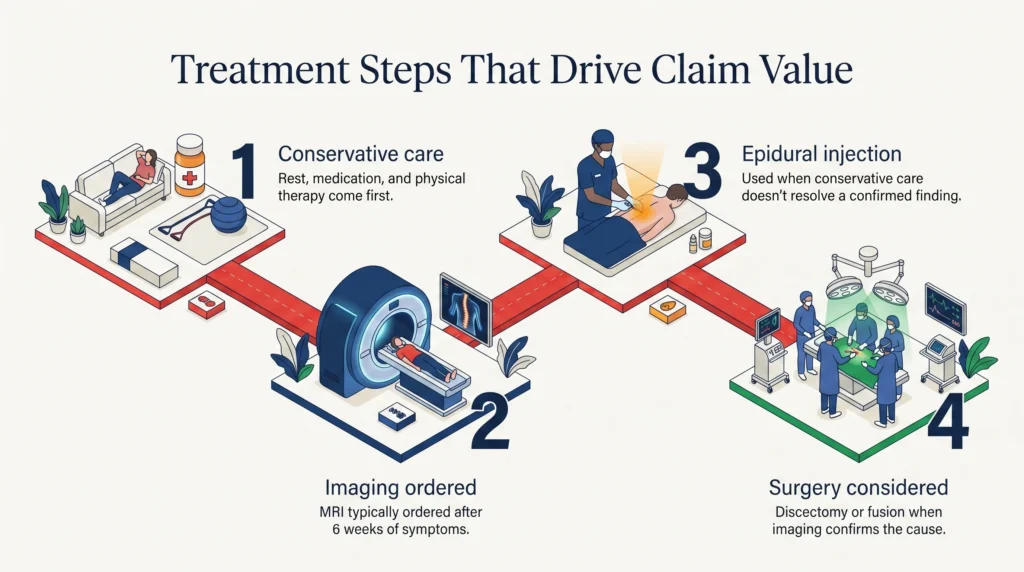
Treatment follows a sequence, and that sequence drives value. Conservative care comes first: rest, medication, and physical therapy, without anything further, resolve 85% to 90% of acute herniated-disc cases within 6 to 12 weeks, per the National Library of Medicine’s lumbar disc herniation reference.
For a neck injury, doctors typically don’t order an MRI until symptoms last at least 6 weeks, unless the pain is severe or getting rapidly worse. A similar wait-and-see approach is also common for back pain. When conservative care doesn’t resolve a confirmed finding, an epidural steroid injection is often the next step. Surgery, such as a discectomy or cervical fusion at C5-C6 or C6-C7, is needed when imaging confirms the cause, and weeks of conservative treatment haven’t worked.
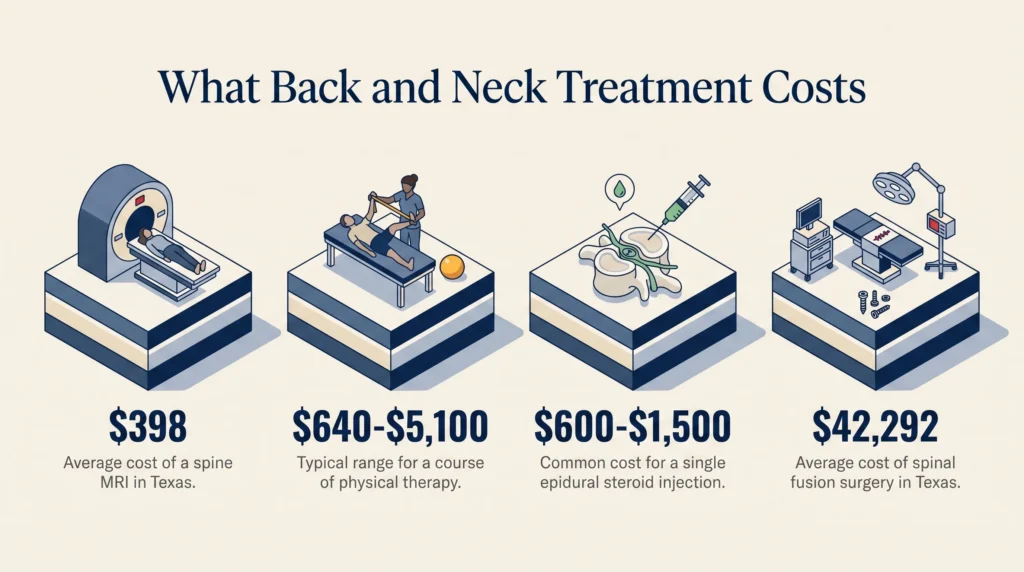
Each tier costs more to treat than the one before it. These figures describe what treatment costs, not what a claim settles for:
- Spine MRI: about $398 in Texas, according to Sidecar Health
- A course of physical therapy: can range from $640 to $5,100 without insurance and depending on the injury type, per Thervo’s pricing guide
- A single epidural steroid injection: commonly $600 to $1,500 according to Pain & Spine Physicians in Texas
- Spinal fusion: about $42,292 in Texas, according to Sidecar Health
The Cleveland Clinic reports an 85% to 95% success rate for anterior cervical discectomy and fusion surgery, with full recovery commonly taking 6 months to a year.
Why Insurers Blame Degeneration, Not the Crash
If your MRI shows disc degeneration, expect the adjuster to argue your pain predates the crash. That argument leans on a real fact: degenerative disc findings are extremely common in people who have no pain at all, and the rate climbs with age. A systematic review found disc degeneration identified through imaging in 37% of asymptomatic 20-year-olds rose to 96% in asymptomatic 80-year-olds, according to Brinjikji and colleagues’ review in the American Journal of Neuroradiology.
By itself, a degenerative MRI doesn’t prove your pain came from something other than the crash. It just means degeneration alone isn’t enough evidence.
Radiologists can look closer. Vertebral endplate changes called Modic type 1, marked by inflammation and fluid, point toward a recent injury. The fatty, drier Modic type 2 pattern points toward long-standing degeneration instead, according to research published in the American Journal of Roentgenology. That distinction, read by the right specialist, is the medical basis for a causation opinion connecting your specific finding to your specific crash.
You also don’t lose your claim just because you had a prior back or neck problem. Texas courts have long recognized that the at-fault party is liable for aggravating a preexisting condition, not only for causing a brand-new one, a principle at issue in the Texas Supreme Court’s 1955 decision in Yellow Cab and Baggage Company v. Green. The practical answer to “it’s just degeneration” is a documented treatment timeline tied to the crash date, plus a specialist’s causation opinion addressing what the MRI actually shows. That’s the work that turns a set of symptoms into a fully documented claim.
What Your Back or Neck Claim Can Cover
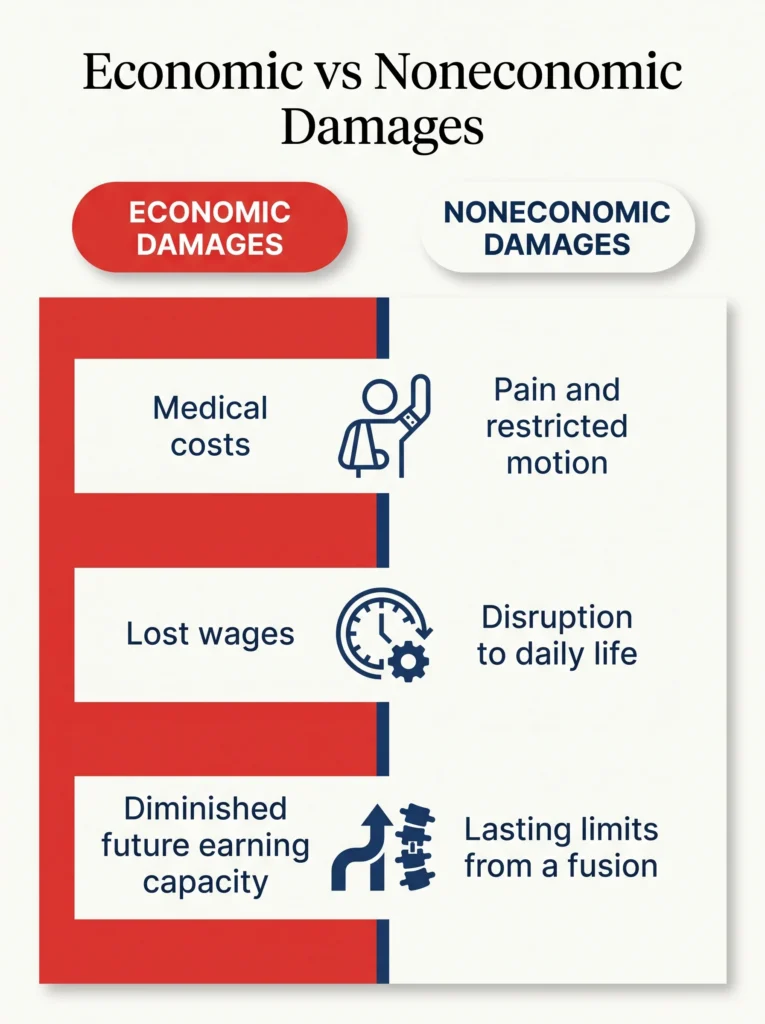
Texas law splits your damages into two categories under Texas Civil Practice and Remedies Code § 41.001. Economic damages cover your actual financial losses: medical costs, lost wages, and, if a fusion or lasting injury limits what you can physically do on the job, diminished future earning capacity as its own separate loss. Ongoing or anticipated care counts as an economic loss even before you’ve paid a bill for it. Noneconomic damages cover the pain, restricted motion, and disruption a real injury causes, and these can add up fast when a fusion leaves lasting limits.
For scale, the average bodily injury liability claim for auto accidents was $24,211 in 2022 using industry claims data, spanning everything from a minor strain to a catastrophic injury. Where a specific back or neck claim lands depends on the treatment level and documentation described above, not on the all-severity average.
What Limits How Much You Can Actually Collect
Two things cap your real-world recovery no matter how well-documented your injury is: your own share of fault, and the insurance actually available to pay you.
Texas follows a 51% bar rule. If you’re found to be more than half responsible for the crash, you recover nothing. At 50% fault or less, your recovery is reduced by your own percentage, under Texas Civil Practice and Remedies Code § 33.001.
Coverage caps the payout too. Texas requires drivers to carry at least $30,000 in bodily injury coverage per person and $60,000 for two or more persons, a minimum set by Texas Transportation Code § 601.072 since January 1, 2011. Insurers must offer uninsured or underinsured motorist (UM/UIM) coverage with every Texas policy, though a driver can reject it in writing, under Texas Insurance Code § 1952.101.
Find the Right Attorney for Your Claim
Sorting out whether your MRI, treatment record, and fault percentage add up to a fair offer is hard to do alone, but you don’t have to. Take our short survey and we’ll match you with an attorney who handles back and neck injury claims like yours, from a conservative-care strain to a cervical fusion. Matching is free, and you only pay attorney fees if the attorney wins. If you aren’t ready and have questions, reach out.