
You searched for the average settlement for a herniated disc car accident claim, and the honest answer is that nobody publishes a real number. Every disc, every treatment path, and every insurance policy is different. What actually sets your claim’s value is a specific set of medical and legal facts, not a multiple of your medical bills.
What Determines Your Disc Injury’s Value?
What actually determines your claim’s value is how your case is evaluated, rather than a set number. For example, what your MRI shows, how many levels are involved, whether the injury is likely permanent, how clearly it ties back to your crash, how far your treatment escalated, how much fault lands on you, and how much insurance is actually available to pay it.
A disc injury with one confirmed level, a clean course of physical therapy, and full resolution in eight weeks is a different claim than one with two confirmed levels, months of injections, and a recommendation for surgery. The medical facts set the ceiling on what your claim can reasonably be worth. The legal facts, fault and available coverage, decide how much of that ceiling you actually collect.
How MRI Findings Prove Your Injury’s Severity
An MRI is what turns “my back hurts” into a provable injury. According to the National Library of Medicine, MRI is the standard tool doctors use to diagnose a disc injury. A diagnosis confirmed on imaging carries far more weight with an insurer than one based on a physical exam alone.
Doctors typically describe a herniation by the specific spinal level it affects, such as L4-L5 or L5-S1. If your MRI shows two confirmed levels instead of one, that generally means a longer and more involved treatment course than a single-level injury, not a claim that’s automatically worth twice as much.
Your treating doctor’s notes are what connect that MRI finding to your crash. A gap between the collision and your first imaging, or notes that never mention the crash at all, gives an insurer room to argue your disc problem came from something else. Closing that gap early, with a doctor who documents the connection while you’re still being treated, does more for your claim than almost anything else you can control.
What Treatment Escalation Typically Costs
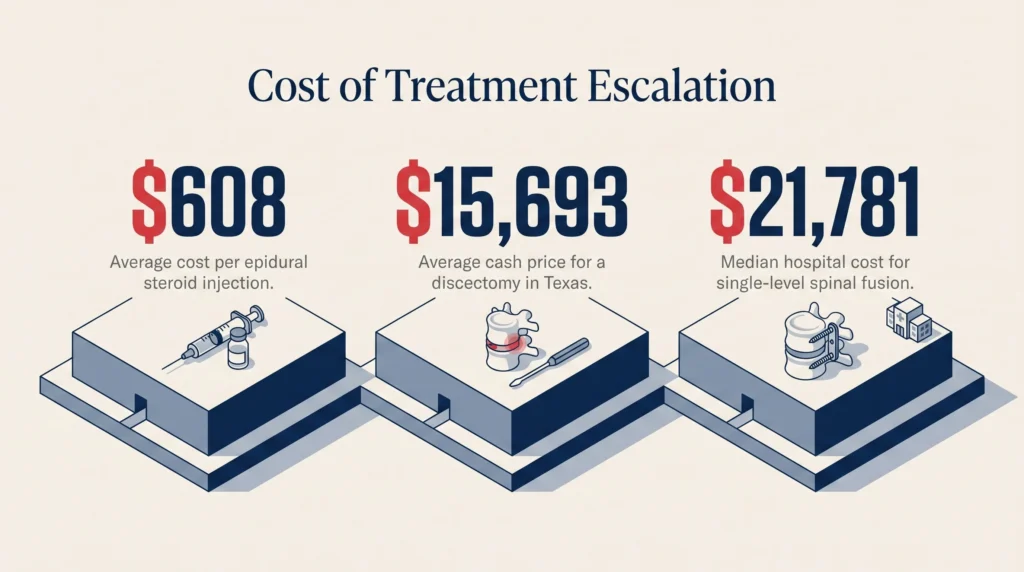
If your disc injury came from a Texas car accident, your treatment path is the clearest evidence of how serious it really is, and each step up that path has a documented cost:
- Epidural steroid injection: A peer-reviewed study in the journal Spine put the average cost at $608 per injection, with most patients in the study receiving about three injections over more than a year.
- Discectomy: When injections haven’t provided enough relief, a doctor may recommend removing the portion of the disc pressing on a nerve. Current Texas pricing data shows a cash-price range of $9,020 to $46,006 for a bundled outpatient procedure, with an average of about $15,693.
- Spinal fusion: A spinal fusion may be recommended when the affected part of the spine is unstable or when other treatments are unlikely to provide lasting relief. A study of single-level fusion patients found a median hospital cost of $21,781, with a reported range from $8,286 to $73,727 in direct hospital costs alone, before surgeon fees and recovery care.
These figures reflect the cost of treatment. They are not estimates of what your case might settle for, and they should not be added together because each figure comes from a different source and measures a different type of expense.
As treatment becomes more extensive, medical records tend to provide stronger evidence of the injury’s severity and financial impact. That evidence, along with factors such as lost income and the effect on your daily life, helps an attorney determine and support the value of your claim.
Why Timing Your Settlement Protects Its Value
Settling before your doctor says you’ve reached maximum medical improvement is one of the most common ways injured drivers leave money on the table. Maximum medical improvement, often shortened to MMI, is the point after which no further healing or recovery from your injury can be expected. It’s the general concept the Texas Department of Insurance uses to describe when treatment for an injury has run its course.
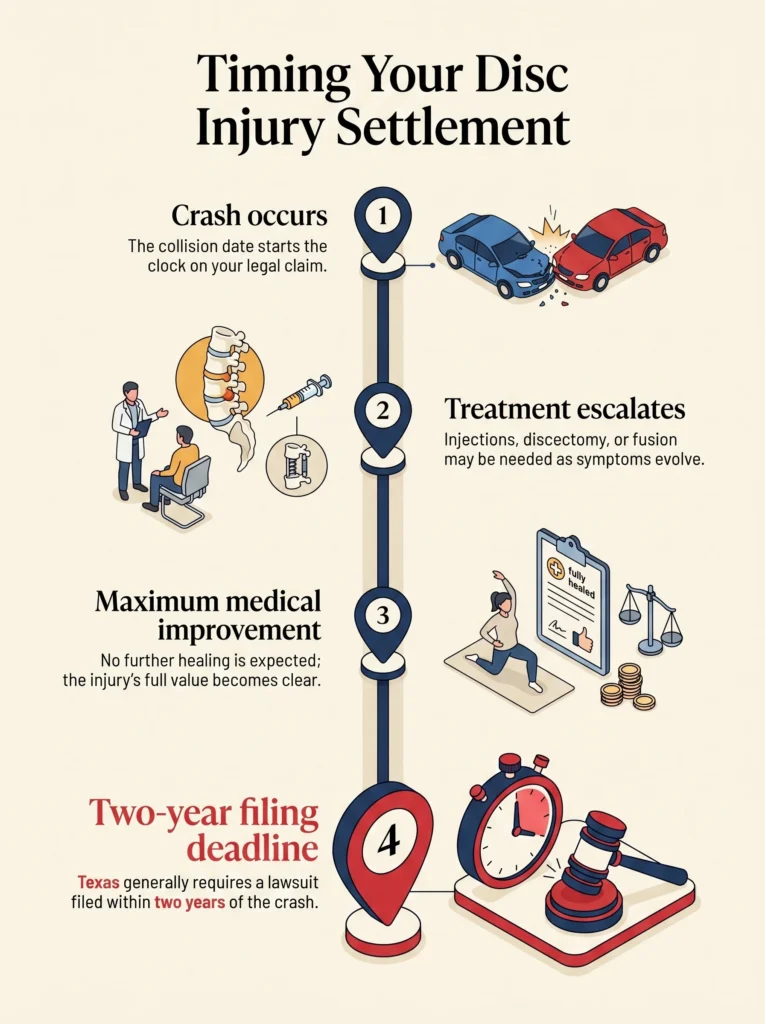
Settle before you reach that point, and you’re guessing at numbers that might still change, like whether your injections resolve things or whether you end up needing a discectomy or fusion instead. Under Texas law, the economic loss you can claim isn’t limited to bills you’ve already paid. Texas statute defines future loss of earnings and earning capacity as loss you can still claim after your case resolves, not only wages already lost by the time you settle.
However, waiting until you reach MMI can create a timing issue. Texas generally gives you two years from the date of your crash to file suit, and that clock doesn’t pause for slow-healing injuries. A disc injury that takes a year or more to play out fully can still need a lawsuit filed to protect it, even while your treatment and any settlement talks continue.
How Fault Affects What You Can Recover
The seriousness of your injury is only one part of the claim. The amount you may recover also depends on who caused the crash and whether you share any responsibility for it.
Texas follows a rule called proportionate responsibility, and it bars you from recovering anything once you’re found more than half responsible for the crash. If your share of responsibility is 50% or less, your recovery is reduced by that percentage.
For example, a driver found 20% at fault on an otherwise well-documented disc injury still collects 80% of that injury’s value. A driver found 51% at fault collects nothing, no matter how serious the disc injury is. It affects how much of your proven damages you may legally recover.
Find an Attorney Who Fits Your Case
You don’t have to work out where your disc injury lands on this framework by yourself. Take our short survey, and we’ll match you with the right attorney for your case, at no cost to you and with no attorney fees unless the attorney wins. If you’d rather ask a few questions first, you can reach out with your questions instead.