You already know your bone is broken; the searing pain leaves no doubt in your mind. But after going to the emergency room, having it set, and being wrapped in a cast, what you actually want to know is what it’s worth. The honest answer depends on more than just your X-ray.
A clean ankle fracture that heals in a walking boot is worth far less than a femur that needed surgery and left you with permanent hardware in your leg. That’s because the injury itself is only one part of the story, as is the long-term impact that the break will have on your life.
How the Actual Value of Your Claim Is Decided
There’s no single dollar figure that fits every broken bone, and any number presented to you as an “average” leaves out the facts that actually determine what your claim may be worth.
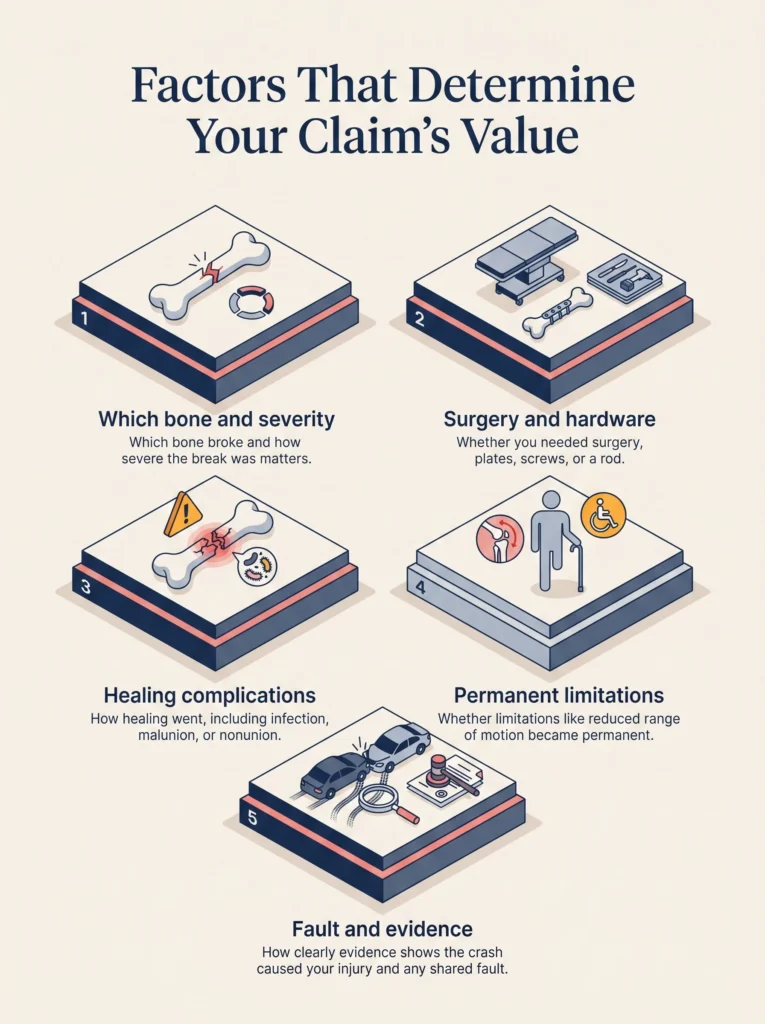
The actual value of your claim depends on several specific factors, including:
- Which bone broke and how severe the break was
- Whether you needed surgery, plates, screws, or a rod to fix it
- How the healing went (including any infection, malunion, or nonunion)
- Whether any limitations turned out to be permanent (like reduced range of motion or arthritis)
- The medical bills and income you’ve already lost
- Your future care needs and whether the injury affects your ability to earn income in the future
- How clearly the evidence shows that the crash caused your injury
- How much of the crash was your own fault (if any)
Which Fractures Are Worth More?
Femur fractures usually sit at the top of the list because they almost always need surgery. Most often, they require open reduction and internal fixation (ORIF), which is when a surgeon lines up the bone and secures it with a metal rod, plates, or screws. According to Cleveland Clinic’s guide to femur fractures, recovery for a broken femur can last anywhere from 4 to 6 months, and it can take up to a year before you’re fully back to normal.
Pelvis fractures rank close behind. According to OrthoInfo’s pelvic fracture guide, pelvic bones sit near major blood vessels and organs, so a pelvic fracture can cause serious bleeding and other injuries beyond the break itself. Additionally, the surrounding muscles can take up to a year to regain their full strength.
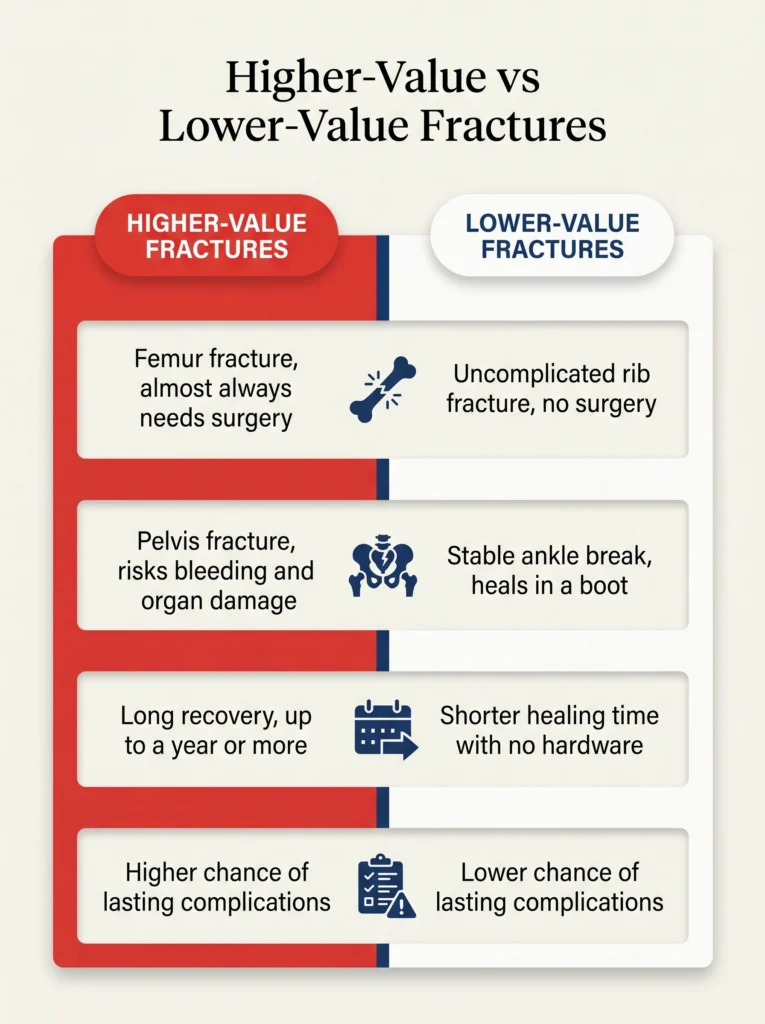
An uncomplicated rib fracture or a stable ankle break that heals in a cast or walking boot without surgery is lower on the list because they require shorter healing time, no hardware, and a lower chance of lasting complications.
Wrist, forearm, and clavicle fractures usually land somewhere in the middle, depending on whether a plate and screws were required, or the injury healed with just a cast and sling.
Why Surgery and Complications Raise the Value of Your Claim
Hardware and complications raise a claim’s value because they can mean more procedures, a longer recovery, or a permanent limitation. A broken femur may include all of these. Beyond the rod, plates, or screws, documented risks also include infection, compartment syndrome, blood clots, and the bone healing out of alignment (malunion) or failing to heal at all (nonunion).
If you broke your wrist, then surgery is common if the break won’t stay aligned on its own. You may need plates, screws, pins, or an external fixator. Most people need to recover for about three months before returning to their previous activities, and full recovery can take up to a year. Even after recovery, almost everyone has some stiffness at first, which can linger for up to two years or longer in rarer cases, according to OrthoInfo’s distal radius fracture guide.
An ankle fracture that needs surgery is usually held together with plates, screws, or a nail. Early healing takes about six weeks, and full recovery can last for up to two years. According to OrthoInfo’s ankle fracture guide, arthritis is a documented complication that can show up years after the original break, and it is a permanent limitation.
Proving the Full Cost of Your Injury
The medical bills you’ve already paid and the paychecks you’ve already missed are only part of the picture. What you were charged isn’t always the same number as your total losses. A responsible claim looks at two categories separately: your present pain and your future care.
Future medical care focuses on the long-term effects of your injury, including further surgeries, hardware removal, physical therapy, and/or ongoing treatment tied to a documented prognosis. Diminished earning capacity looks at how your injury may affect your ability to earn income in the future, not just the wages you’ve already lost.
Proving future losses usually takes more than a diagnosis. You will also need to provide your surgical record, a clear prognosis from your treating doctor, and often an expert who can link your prognosis to your ability to work. An attorney can gather this documentation and determine how to use it to your advantage. This can be the difference between a claim that only covers up to your final hospital bill and a claim that accounts for what your injury will actually cost you over the course of your lifetime.
Texas Rules That May Limit Your Recovery
A few Texas-specific rules apply to any Texas car accident claim, no matter which bone is broken.
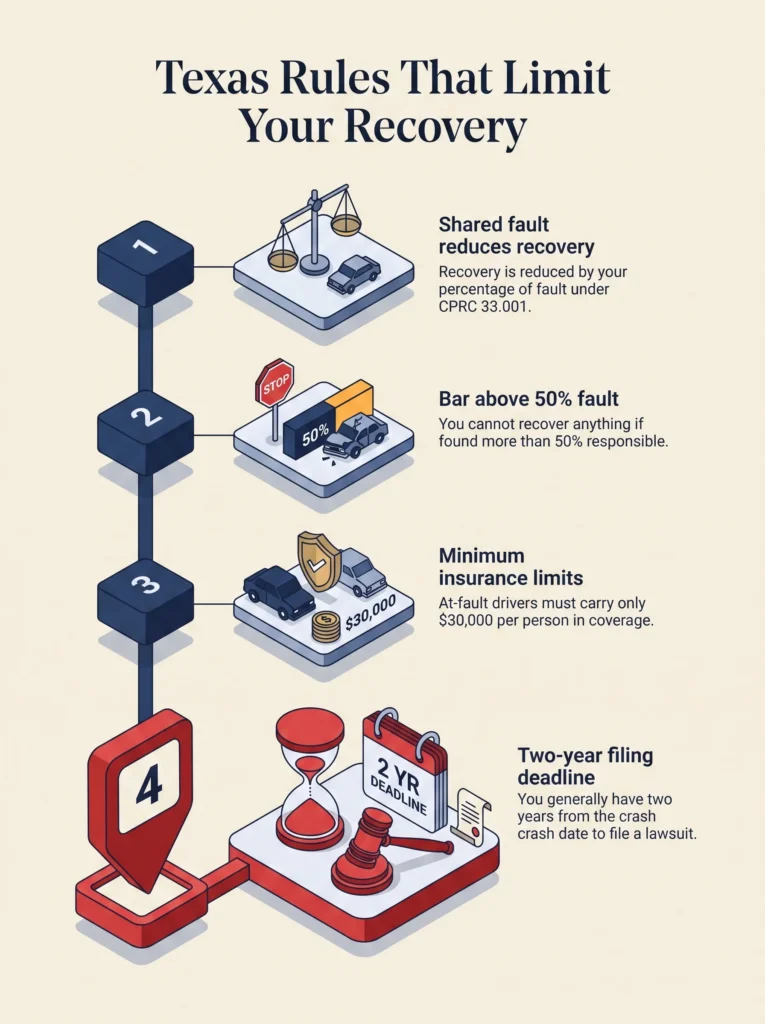
These rules can affect your claim, regardless of how serious your injury is:
- Your filing deadline: Under the Texas Civil Practice and Remedies Code (CPRC) § 16.003, you generally have two years from the date of your crash to file a personal injury lawsuit. If you miss this deadline, you typically lose the right to file a lawsuit at all.
- Shared fault can reduce or bar your recovery: Under CPRC § 33.001, you can’t recover anything if you’re found more than 50% responsible for the crash. If you are found 50% or less responsible, then your total recovery gets reduced by your percentage of fault.
- Minimum insurance can limit what the at-fault driver’s policy pays: Under Texas Transportation Code § 601.072, drivers only have to carry $30,000 per person and $60,000 per accident in bodily injury coverage. If that’s all the other driver has, then a high-value fracture claim can be worth more than what their policy alone can pay. Other coverage sources (like your own underinsured motorist policy) can help bridge the gap.
These deadlines and percentages follow a fixed timeline, so acting early will help protect the value of your claim.
Find the Right Attorney for Your Claim
A good attorney will document your surgery, time spent healing, missed paychecks, and future care to build the actual value of your claim. You shouldn’t have to piece all that together on your own while you’re still healing.
That’s what TCN is for. We’re a free matching service, not a law firm, and we connect injured Texans with an experienced attorney who is suited to a fracture claim like yours. Our partner attorneys work on a contingency basis, which means you pay no fees or upfront costs unless they win your case.
Take our short survey and we’ll match you with the right attorney for your situation. If you’re not ready for that, you can also reach out with questions first.