
If you’ve been in a car accident and suffered injuries, you might be wondering about your options. It doesn’t take long for bills to start piling up, which can be frustrating and stressful if you’ve also had to miss time at work to recover. Internet research might tell you your claim is worth one amount, while a friend might say they went through the process and got a different one. What’s the truth? How much is a car accident claim worth?
Unfortunately, the answer isn’t as simple as the question: there is no “average” car accident settlement. What sets your claim’s value is a short list of factors, and once you know them, you can start sizing up your own situation instead of guessing at someone else’s average.
Car Accident Claim Value in Texas
Your injuries, your share of the fault, and the available insurance coverage usually have the greatest effect on what your claim may be worth. A serious injury can create substantial losses, but fault or limited coverage can reduce how much you’re realistically able to recover.
That’s why a statewide “average settlement” won’t tell you much about your own claim. You need to look at each of these factors separately.
How Fault Affects Your Claim’s Value
Texas follows a modified comparative-fault rule under the Texas Civil Practice and Remedies Code (CPRC) § 33.001. If you’re 50 percent responsible for the crash or less, you can still recover, but your payout gets reduced by your own share of the fault. Once you cross 51 percent responsibility, Texas law bars you from recovering anything at all, no matter what the other driver also did wrong.
Say your total damages add up to $100,000, and an adjuster or a jury decides you were 20 percent at fault, maybe for following a little too close. You’d still recover $80,000. Fault trims your recovery instead of erasing it, all the way up to the 51 percent line.
Fault percentages don’t get handed down from nowhere. They get argued over, based on police reports, witness statements, and physical evidence, which is exactly the kind of work that shapes what your claim ends up worth.
How Insurance Coverage Limits Your Claim
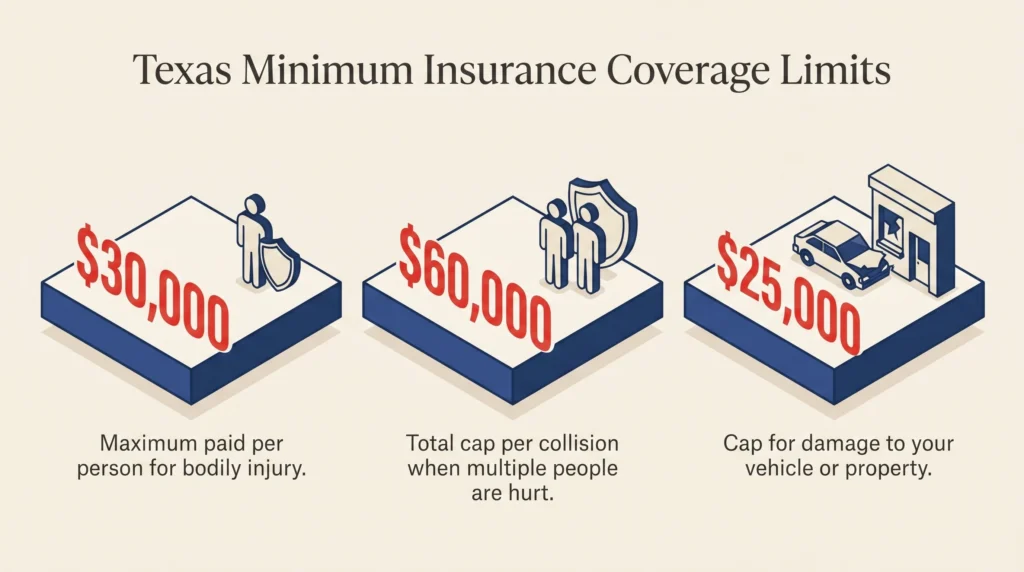
Every Texas driver is required to carry at least $30,000 per person and $60,000 per collision in bodily injury coverage, plus $25,000 in property damage coverage, the state’s “30/60/25” minimum under Texas Transportation Code § 601.072. Broken down, that means:
- $30,000: the most the at-fault driver’s insurer pays for injury to any one person
- $60,000: the total cap per collision when more than one person is hurt
- $25,000: the cap for damage to your vehicle or other property
That $30,000 per-person figure is often nowhere near enough to cover a serious injury, and Texas doesn’t require drivers to carry more. On top of that, Texas’s own insurance-verification program estimated that 11.87 percent of Texas drivers carried no insurance at all as of September 2025, and other public estimates put that share higher still.
That gap is why insurance limits can restrict how much money is realistically available, even when your documented losses are much higher. If the at-fault driver only carries the state minimum, or none at all, the rest of what you’re owed may need to come from your own uninsured or underinsured motorist coverage, a commercial policy if a work vehicle was involved, or another party who shares responsibility. This coverage-layer problem shows up across the full range of car accident claims, not only the most serious ones.
How Injury Severity Shapes Claim Value
The more serious your injury is, the more your claim may be worth. On the low end, the Healthcare Cost and Utilization Project, run by the federal Agency for Healthcare Research and Quality, puts the national average cost of an ER visit at $530, using 2017 figures. That number could be slightly higher now, but consider that amount for a same-day ER visit and release.
The numbers can climb quickly when an injury causes permanent limitations. According to 2023 spinal cord injury cost data from the National Spinal Cord Injury Statistical Center, the estimated lifetime costs for someone injured at age 25 are about $2.85 million for paraplegia, $4.26 million for low tetraplegia, and $5.84 million for high tetraplegia.
Those figures cover estimated health care and living expenses, not a guaranteed settlement. Most car accident injuries won’t reach those amounts. However, a fracture that requires surgery, physical therapy, and months of follow-up care can still result in substantial costs, even though there isn’t one reliable published figure for injuries in this middle range.
That’s why your claim gets built from your own documented costs, not from someone else’s average.
Past Medical Bills & Lost Wages
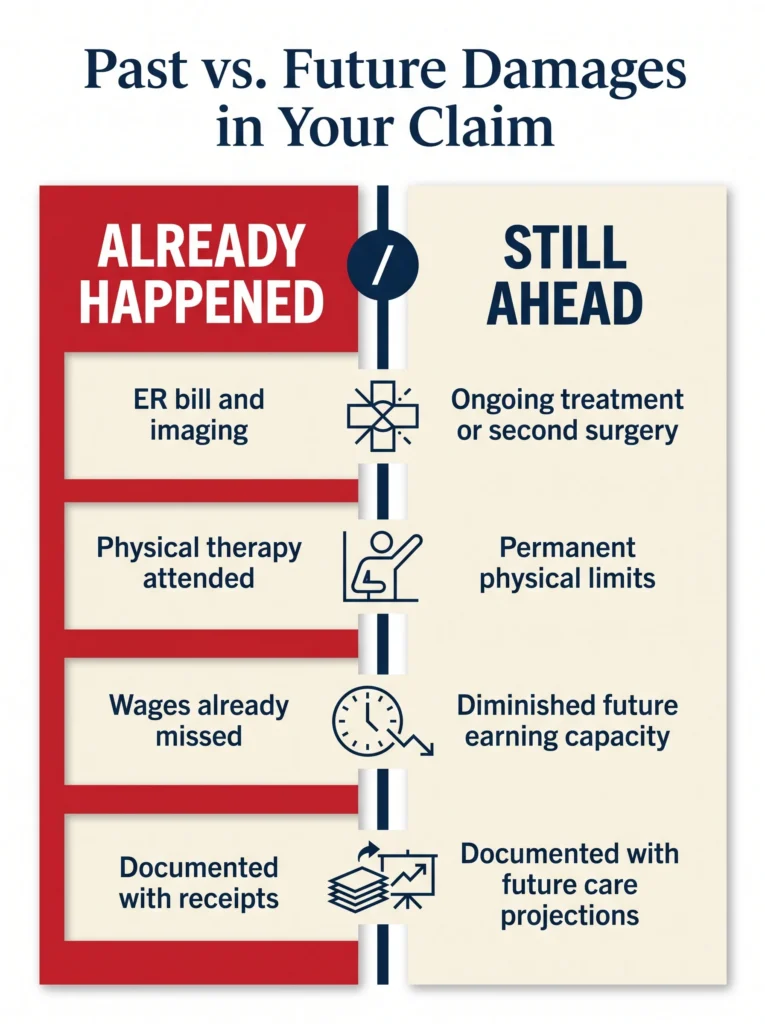
The easiest part of your claim to prove is what’s already happened. Things like your ER bill, your imaging, the physical therapy you’ve already attended, and the wages you’ve already missed while you couldn’t work. Each of these gets documented the moment it happens, with a receipt, a bill, or a pay stub behind every dollar.
Future Care & Diminished Earning Capacity
If your prognosis includes ongoing treatment, a second surgery, or permanent physical limits that reduce what kind of work you can do going forward, those are still economic damages. A reduced capacity to earn is a financial loss, and it belongs in the same column as your medical bills, not off to the side.
What an Attorney Adds to Your Claim
An experienced attorney can investigate the crash, identify every party who may be responsible, and find all available sources of insurance coverage. That can be difficult to do on your own, especially when the claim may involve more than the driver who hit you.
Depending on the accident, additional coverage could include:
- Your own uninsured or underinsured motorist coverage
- A commercial policy, if a work vehicle was involved
- A second driver or party who shares responsibility for the crash
The other part is documentation: building a complete, evidence-backed record across every damage category, including the future care and lost earning capacity described above, not just the bills you’ve already paid. An insurance adjuster wants to settle your claim for as little as possible, and a fully documented claim is much harder to lowball than an incomplete one.
None of this comes with a guaranteed price tag. What a good attorney offers isn’t a promised number. It’s the investigation and documentation that let your specific facts, not somebody else’s average, set your claim’s real value.
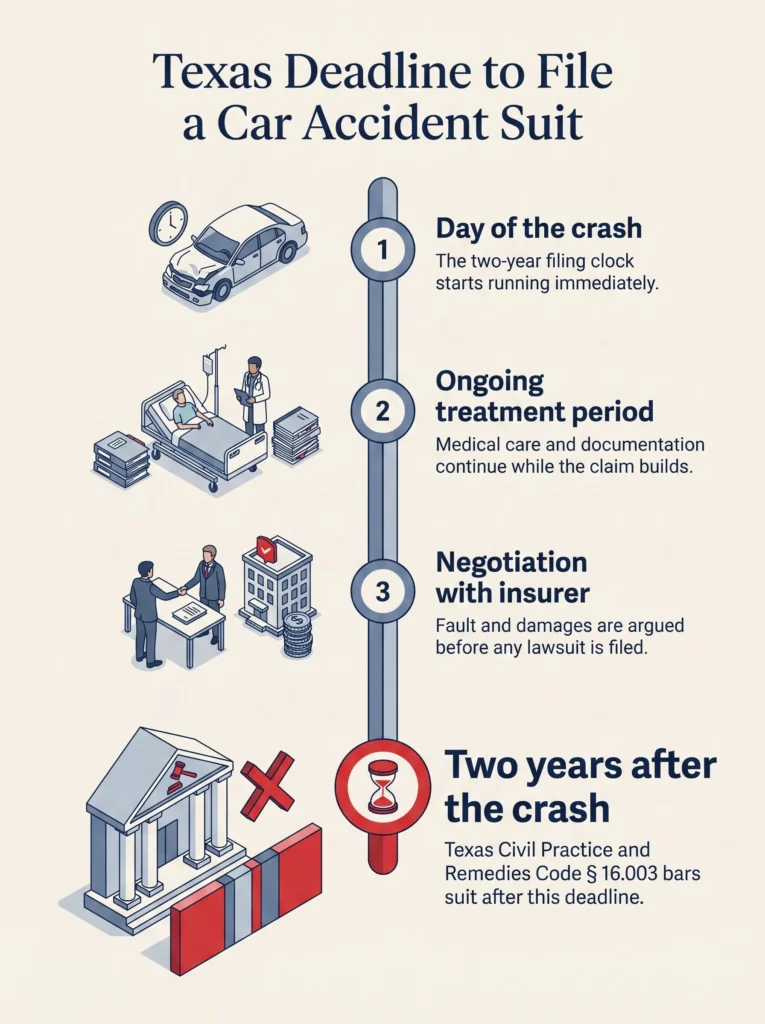
Texas gives you two years from the crash to file suit under the Texas Civil Practice and Remedies Code § 16.003. Once that window closes, an otherwise strong claim is generally worth nothing at all.
Find the Right Attorney for Your Claim
You don’t have to sort out fault percentages, insurance layers, and damage categories on your own. Texas Crash Network is an independent attorney-matching network for injured Texans. A short survey can match you with an experienced attorney who fits your situation at no cost to you. The attorneys in the network work on a no-win, no-fee basis, so you owe nothing unless they win.
If you’re not ready for that yet and just have a few questions first, reach out to Texas Crash Network directly instead. Either way, the sooner you start, the more of your claim’s real value stays provable.
Last reviewed: August 2026. This page explains how car accident claims are valued in Texas. It does not predict the value of any specific claim. For information about a specific case, speak with an attorney.