One moment, you were caught in a chain-reaction crash involving several vehicles. The next, insurance adjusters you’ve never spoken to were calling about a collision you didn’t cause.
Multi-vehicle accidents are often far more complicated than a typical two-car crash. Determining who is responsible, how fault is divided, and what compensation may be available usually involves multiple drivers, insurers, and competing claims.
What Decides Your Pileup Claim’s Value?
Three things decide what your claim is worth:
- The severity and cost of your injuries
- Your percentage of fault for the accident
- How much insurance money is available to you
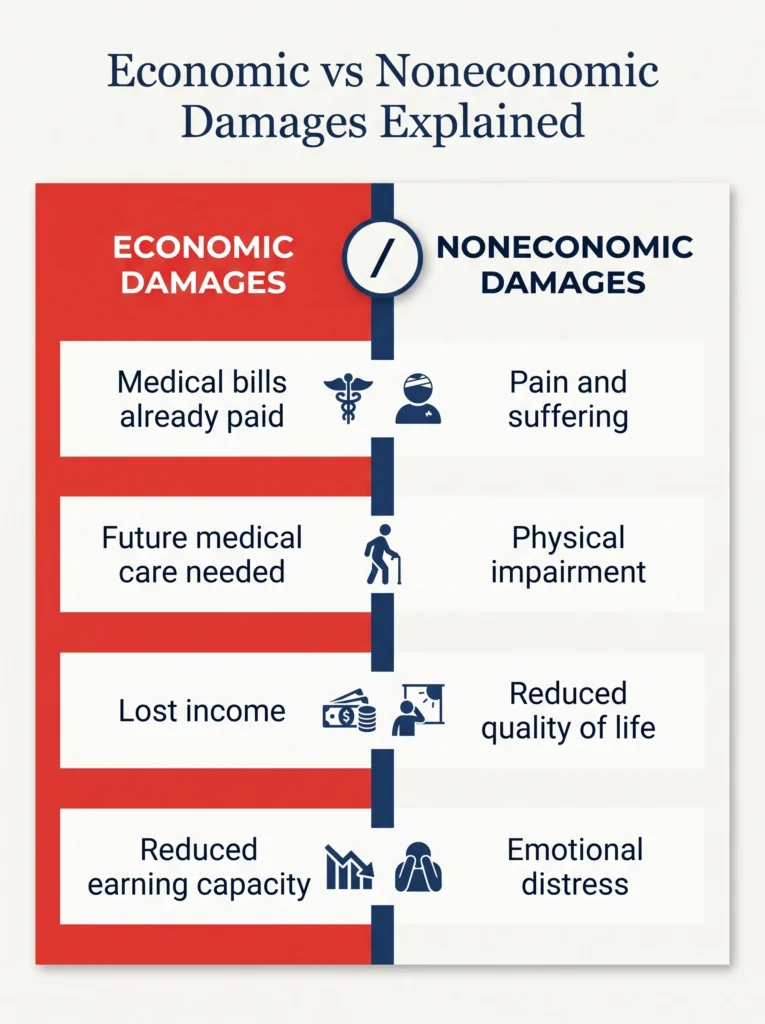
Additionally, Texas Civil Practice and Remedies Code (CPRC) § 41.001 splits your losses into two categories:
Economic damages cover your actual costs: medical bills that you have already paid, medical care that you may need later, and lost income or a reduced ability to earn what you used to before the accident.
Noneconomic damages cover the pain, suffering, and physical impairment that your injuries leave behind.
There is no true average for a multi-car pileup settlement. A crash that injured six people will pay out differently for each person involved because the value of each claim depends on each person’s specific injuries, not just the number of cars in the pileup.
Who’s at Fault After a Chain Reaction?
Under CPRC § 33.003, every driver in the pileup will be assigned a percentage of fault by a judge or jury based on how the crash actually unfolded, and that percentage will determine how much you can recover.
Your percentage of fault changes what you can recover. If you are found 50% or less at fault, then your recovery will be reduced by your percentage of fault, under CPRC § 33.001. If you are found to be more than 50% at fault, then you recover nothing. Additionally, you may become liable for the full recoverable amount under CPRC § 33.013.
In a multi-vehicle collision, this often requires experts to reconstruct the crash by reviewing vehicle damage, the resting position of each vehicle, and any witness or dashcam video footage. The driver who caused the first collision is not automatically responsible for the second driver, who may have been following too closely and caused a separate impact of their own.
Insurers often assign percentages of fault early in settlement talks, but these percentages are only one part of settlement negotiations and are not a final legal determination. As reconstruction evidence becomes available, fault allocation may change.
How Insurance Limits Affect Multiple Claims
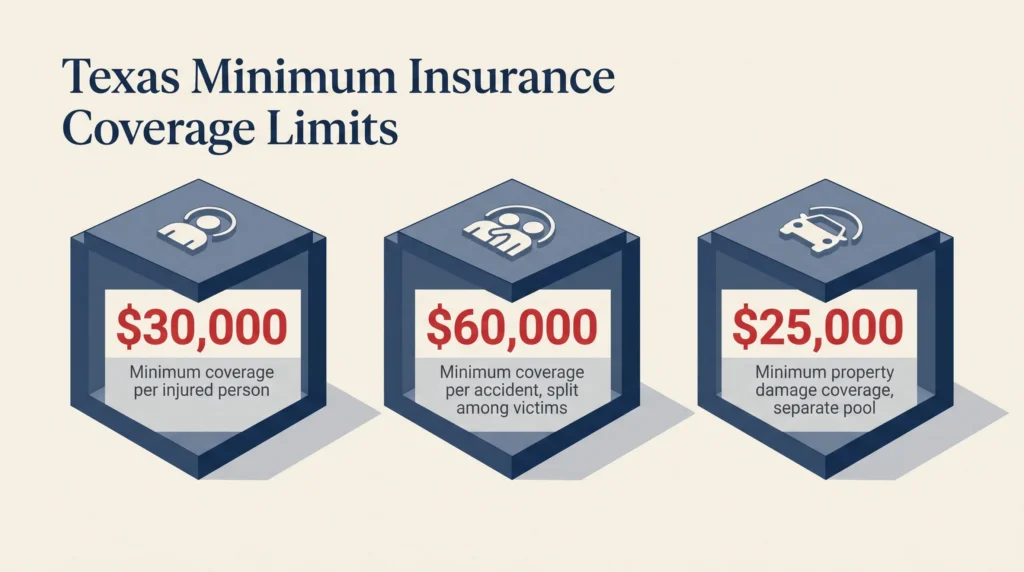
Under Texas Transportation Code § 601.072, the state’s minimum liability coverage is $30,000 per person, $60,000 per accident, and $25,000 for property damage (also known as “30/60/25”). The $60,000 per accident total does not apply per victim. Instead, it is split across every person involved in the crash, so two or three injured claimants can easily burn through that amount quickly.
A multi-car pileup is still handled as a car accident claim, but because there is usually more than one at-fault driver, there is also more than one policy to identify and pursue. Some drivers carry higher limits than the state minimum, so identifying all available insurance coverage is an important part of building a claim.
How Filing Early Protects Your Claim
Texas courts have recognized that when one driver’s policy is not enough to cover everyone injured in the crash, the insurer is generally allowed to pay claims as they come in. This means that an insurer who is facing more claims than one policy can pay can settle in good faith with one claimant first, even if that uses up the money left for the others. A claimant who wants to challenge this practice must prove that the insurer acted unreasonably or in bad faith.
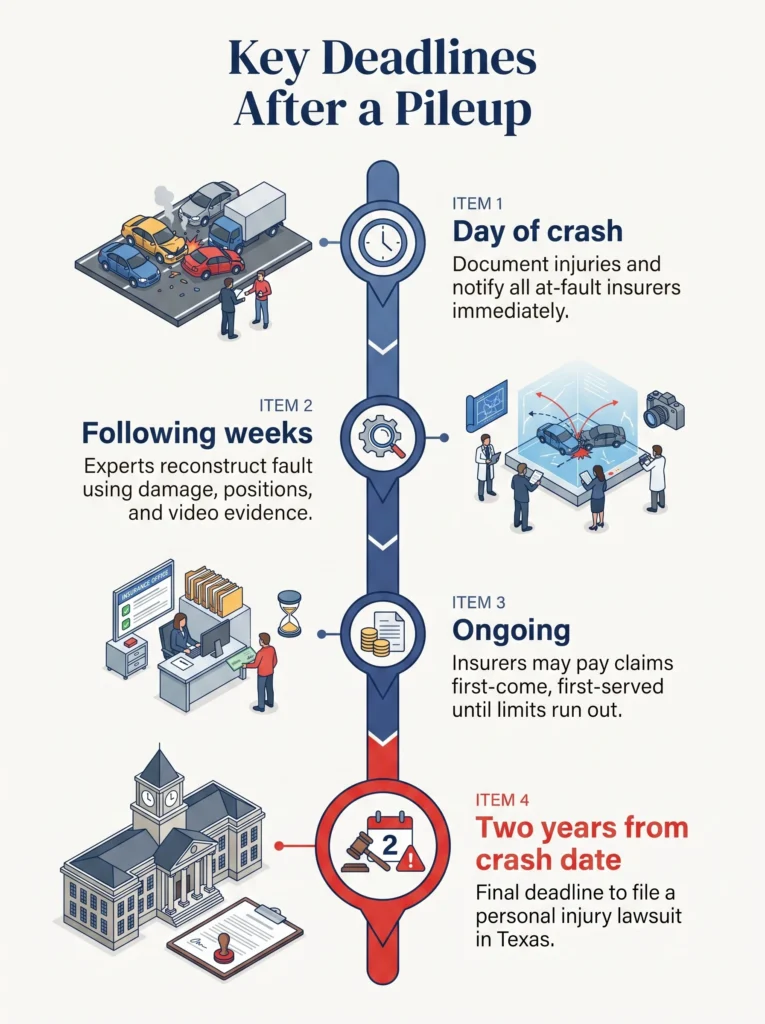
Documenting your injuries and notifying every at-fault driver’s insurer as quickly as possible is the best way to ensure that your claim is paid.
Under CPRC § 16.003, you have two years from the date of the crash to file a personal injury lawsuit in Texas. Determining fault percentages and sorting through multiple policies takes time, so it’s important to file your claim as soon as possible.
Understanding Your UM/UIM Coverage
If the coverage from every at-fault driver is either used up or not enough to cover your injuries, then your own uninsured or underinsured motorist coverage can cover the remaining amount.
UM/UIM is a claim against your own insurer, and it is separate from any at-fault driver’s policy. Under Texas Insurance Code § 1952.101, Texas insurers must include uninsured or underinsured motorist (UM/UIM) coverage in your policy unless you reject it in writing.
Find the Right Attorney for Your Claim
Determining liability and available insurance coverage after a multi-vehicle pileup can be complicated, especially with several drivers, insurers, and one limited pool of money at stake. The good news is this is exactly the kind of reconstruction work that experienced attorneys handle every day, and Texas Crash Network can help match you with one.
Take our short survey, and we’ll match you with the right attorney for your claim. Matching is free, and you pay no attorney fees unless your attorney wins your case. You can also reach out to us with no pressure and ask us any questions you may have.